
Key Points
-
Most day-to-day swings are variance. Diagnose on multi-day trends against a 30-day baseline, not single days.
-
If an ad set cannot reach ~50 conversions per week, expect “learning limited” and unstable delivery.
-
Budget rule of thumb: daily budget ≈ target CPA × 7. Underfunding creates fake volatility.
-
Consolidate overlapping ad sets to increase data density and stop internal auction cannibalization.
-
Refresh creative on a schedule and monitor frequency; rising frequency with falling CTR means fatigue.
-
Add guardrails: automated rules for CPA, spend, and frequency to catch true drift early.
-
Fix tracking first. Bad signals cause the worst “volatility” because the system learns from noise.
Common Signs of Unstable Meta Ads Performance
Recognizing genuine volatility starts with identifying patterns that extend beyond normal day-to-day fluctuations.Notable, short-term spikes or drops in key metrics like Cost Per Mille (CPM), Click-Through Rate (CTR), or Conversion Rate often indicate real instability in ad delivery or platform algorithm changes.
The most telling signs include campaigns persistently stuck in the learning phase, marked as “learning limited” for weeks on end. These campaigns signal ongoing volatility and optimization struggles. You’ll also notice irregularities in daily results—inconsistent delivery patterns where your ads reach vastly different audience sizes without clear explanation.
High frequency rates combined with declining engagement suggest audience fatigue, particularly when you’re over-targeting the same users.Industry experts have observed increased discrepancies between Meta’s reported return on ad spend (ROAS) and actual on-site revenue, often due to evolving privacy regulations and shortened attribution windows.
Another red flag emerges whenads that previously performed well suddenly receive low relevance scores or reduced engagement. This often traces back to rapid shifts in user behavior, audience overlap, or platform algorithm changes that affect how your content resonates with users.
The Root Causes of Meta Ads Volatility
Algorithm Changes and Platform Updates
Meta continuously updates its ad delivery algorithms, with greater reliance on AI and machine learning creating unexpected performance shifts.These changes can cause abrupt shifts in performance as the system re-learns optimization parameters or emphasizes new signals, leading to temporary instability.
The platform’sprobabilistic models aggregate many signals—engagement, clicks, interactions—to forecast likely outcomes. Understanding this helps explain why day-to-day swings occur naturally as Meta processes thousands of data points to predict user behavior.
Seasonal and Market Fluctuations
External factors create legitimate performance swings that have nothing to do with your campaign setup. Holiday shopping seasons, major news events, or competitor activity can dramatically shift user attention and bidding competition.Daily CPM spikes and performance swings are influenced by fluctuations in advertiser competition, macroeconomic trends, and seasonal demand cycles.
These market forces require broader trend analysis rather than day-to-day optimization reactions. Smart advertisers track these patterns annually to anticipate and prepare for predictable seasonal shifts.
Account-Specific Performance Issues
Many volatility issues stem from structural problems within your account setup.Running too many ads within a single ad set or having overlapping targeting structures confuses the delivery system and spreads available data thinly across too many variables.
Suboptimal account architecture creates internal competition between your own ad sets, driving up costs while reducing efficiency. Overlapping audiences cause ad sets to compete against each other in the same auctions, artificially inflating your bidding costs.
Systematic Approach to Diagnosing Meta Ads Volatility
Initial Performance Assessment Framework
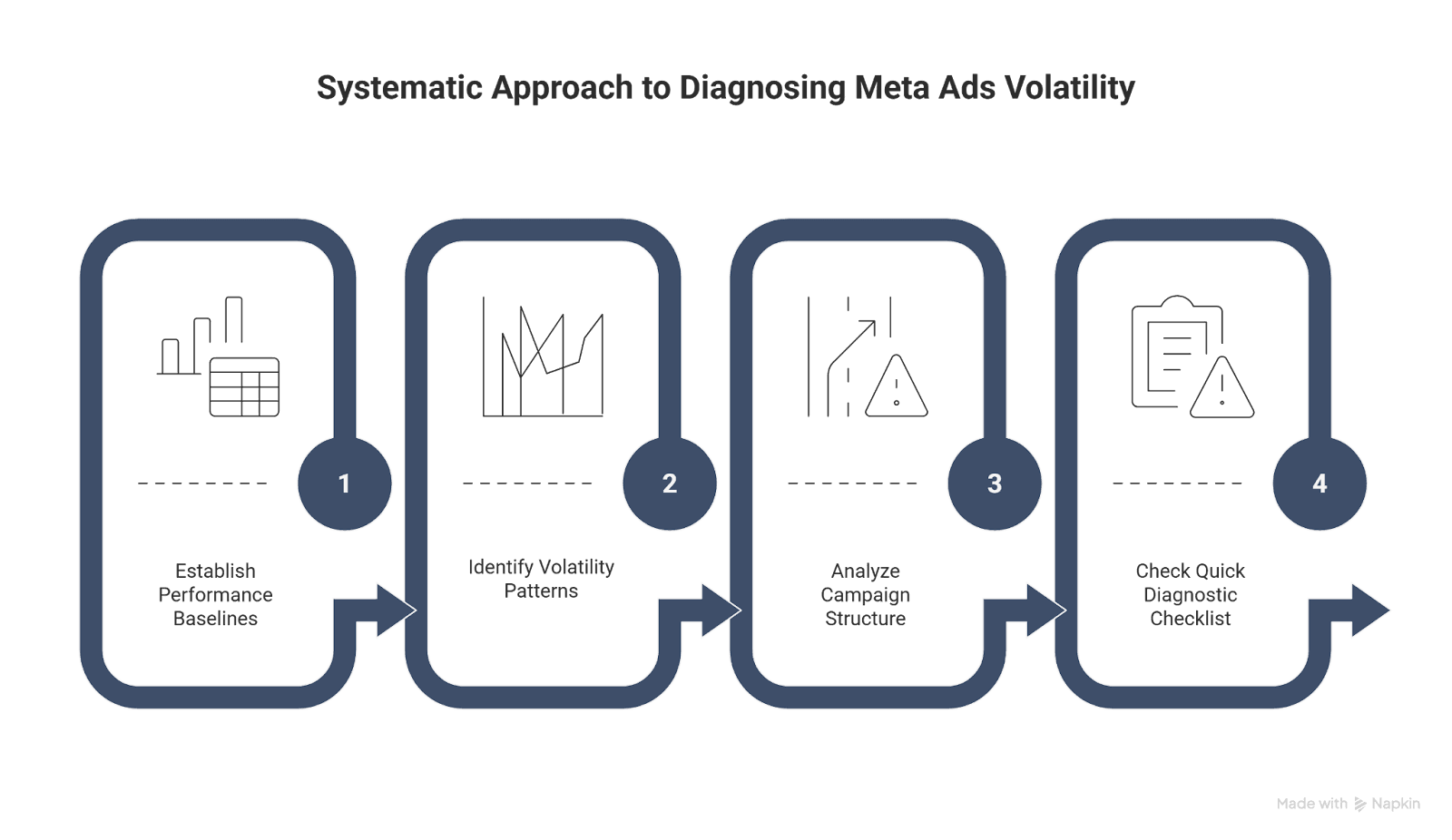
Establishing Performance Baselines
Effective volatility diagnosis begins with understanding what normal looks like for your specific account. Rather than reacting to every performance dip,examine data patterns over a statistically significant window to distinguish random fluctuation from genuine issues.
Historical data analysis spanning at least 30 days provides the context needed to identify true deviations from normal performance. This baseline approach prevents overreacting to natural statistical variation while ensuring you catch genuine problems early.
Identifying Volatility Patterns and Trends
Look for sustained changes rather than single-day anomalies. Meta’s algorithm processes countless variables daily, so temporary swings often resolve themselves without intervention. Focus on trends that persist across multiple days or show clear directional changes in key metrics.
Thesample size of events plays a crucial role in diagnosis. Many perceived volatility issues arise from drawing conclusions from too few data points, leading to misattribution of normal variation to systemic problems.
Campaign Structure Analysis
Learning Phase Disruptions and Restarts
Meta’s official guidelines emphasize that campaigns requireapproximately 50 conversion events per ad set per week to exit the learning phase and achieve stable performance. Falling below this threshold triggers “learning limited” status, preventing efficient optimization and creating ongoing performance instability.
Micromanaging campaigns with frequent creative swaps, bid changes, or budget adjustments disrupts the learning phase, limiting the algorithm’s opportunity to find optimal combinations. Each disruption essentially resets the optimization process, creating the appearance of volatility.
Budget Distribution and Allocation Issues
Meta recommends calculating daily budget by multiplying expected CPA byminimum conversion threshold, typically 50 per week, then dividing by seven. Underfunded ad sets struggle to generate sufficient optimization events, leading to poor performance and increased volatility.
Spreading budgets too thin across multiple ad sets prevents any single set from achieving the conversion volume needed for stable optimization. This creates a cycle where none of your ad sets perform optimally, leading to account-wide instability.
Ad Set Oversegmentation Problems
Excessive segmentation dilutes your data and creates internal competition between ad sets targeting similar audiences.Advertisers report CPMs can be 15-25% higher and conversion rates 10-40% lower for campaigns with insufficient conversion events, relative to optimized campaigns.
Consolidating similar ad sets improves data density and supports faster optimization.Use of overly restrictive targeting or splitting conversions across too many ad sets can result in a 49% lower ROAS versus broad targeting approaches.
If your account is split to dust, request a free structure audit and we’ll outline a two-ad-set plan.
Quick Diagnostic Checklist
Before diving deep into complex analysis, run through this rapid assessment:
-
Is the learning phase stuck at “Learning Limited” for over a week?
-
Has daily budget dropped below the recommended CPA × 7 threshold?
-
Are multiple ad sets targeting overlapping audiences?
-
Have you made significant changes to campaigns in the past 7 days?
-
Is conversion tracking properly configured and firing consistently?
-
Are frequency rates climbing above 2.5 for the same audiences?
Addressing these fundamental issues often resolves apparent volatility without complex troubleshooting.
Technical Factors Causing Performance Instability
Pixel Implementation and Data Quality Issues
Conversion Tracking Inconsistencies
Proper pixel implementation forms the foundation of stable Meta ads performance.Meta’s attribution models and their configuration are a core source of performance misalignment, especially when tracking setup contains errors or missing events.
Inadequate signal quality hinders Meta’s machine learning ability to optimize campaigns accurately. The algorithm relies on consistent, accurate conversion data to make informed delivery decisions and improve performance over time.
iOS 14.5+ Attribution Challenges
Privacy updates have significantly impacted data collection capabilities, affecting attribution accuracy and creating discrepancies in reported results. These limitations require adaptive measurement strategies to account for reduced tracking capabilities while maintaining optimization effectiveness.
Bidding Strategy and Budget Problems
Manual vs Automatic Bidding Misalignment
Choosing inappropriate bidding strategies for your campaign objectives creates unpredictable spend patterns and results. Manual bidding requires careful calibration based on historical performance, while automatic bidding depends on sufficient conversion data for stable optimization.
Recent case studies demonstrate the importance of realistic bid caps. One eCommerce brand saw delivery stall and CPA spike when cost cap bidding was set at $35, below their true break-even point. Afteradjusting to $50, they achieved 23 purchases in 30 days compared to just 4 conversions in the previous two weeks.
Budget Fluctuations and Minimum Thresholds
Sudden budget changes destabilize the learning process and campaign performance. Each ad set requires adequate minimum budget levels to reach conversion targets and support algorithm learning effectively. Multiple brands have discovered thatdoubling budgets can drop ROAS by 30% in a single week, requiring careful reset and creative refresh to restore stability.
Creative Performance and Ad Fatigue
Creative Rotation and Refresh Strategies
Failing to refresh creative assets leads to audience fatigue, reducing engagement while increasing costs.Video ads reduce cost-per-engagement by up to 30% and user-generated content achievesup to 4x higher CTR, making diverse creative approaches essential for sustained performance.
Proven Solutions for Stabilizing Meta Ads Performance
Campaign Optimization Strategies
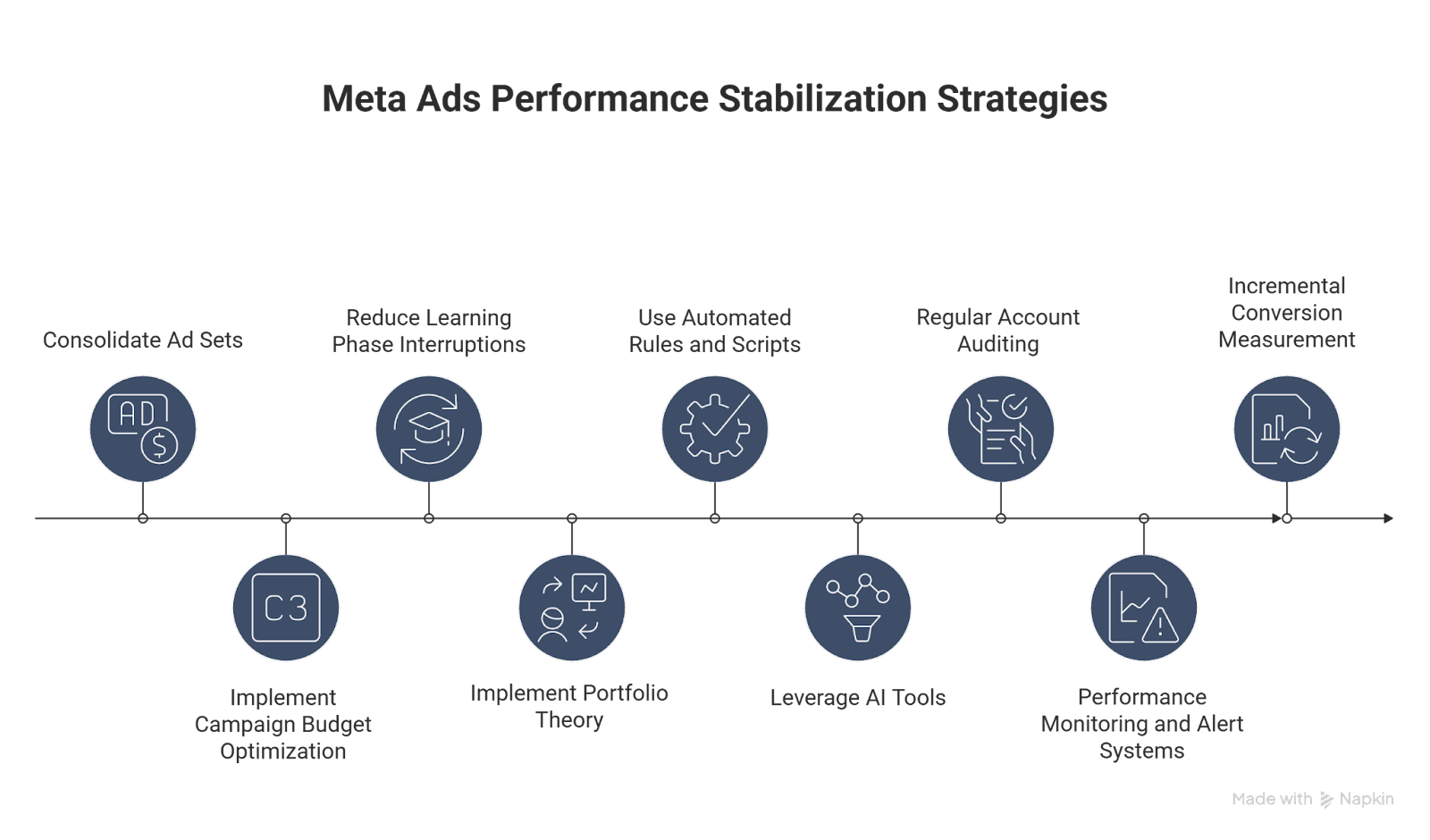
Consolidating Ad Sets for Better Performance
Merging similar ad sets concentrates budget and data, accelerating learning while reducing internal competition. Recent data shows conversion rates vary dramatically by industry, withfitness achieving 14.29% while retail averages3.26%. Understanding these benchmarks helps set realistic expectations for consolidated campaigns.
Fewer, larger ad sets support more stable optimization and predictable performance outcomes. This approach aligns with Meta’s recommendation for sufficient conversion volume per optimization unit.
Implementing Campaign Budget Optimization
Centralizing budget control at the campaign level enables smarter allocation based on real-time performance data.Lead generation campaigns currently deliver the highest engagement with average CTR of 2.53% and conversion rate of 8.78%, making them ideal candidates for automated budget optimization.
Reducing Learning Phase Interruptions
Plan and group necessary campaign changes to minimize learning phase resets. Meta’s official guidance emphasizesavoiding excessive edits during learning phase, as changes to budget, targeting, or creative reset the optimization process and cause performance fluctuations.
We group changes and use rules to avoid resets; see success studies for the cadence we run.
Advanced Stabilization Techniques
Implementing Portfolio Theory for Meta Ads
Diversifying campaign strategies across different objectives and audience segments creates a more resilient account structure. This approach helps smooth out performance volatility by balancing risk across multiple campaign types and optimization goals.
Using Automated Rules and Scripts
Automated rules monitor performance metrics and make real-time adjustments, reducing manual intervention errors while maintaining account health. These systems help enforce spending thresholds and pause underperforming assets based on predetermined criteria, essential given thatAI automation shows up to 30% CPA reduction.
Leveraging AI Tools for Performance Management
AI-driven platforms offer actionable insights and automate routine optimizations while monitoring key metrics for early volatility detection. These tools maintain consistency and free up time for strategic campaign planning and analysis.
Long-term Performance Management
Regular Account Auditing Schedules
Meta recommendsperiodic account audits to review ad account structure, audience settings, and conversion events. Scheduled audits identify structural issues, outdated targeting parameters, and optimization opportunities before they impact performance.
Performance Monitoring and Alert Systems
Daily and weekly monitoring of key indicators enables proactive management and quick response to emerging issues.Validate proper pixel firing and event mapping post-click, ensuring no misalignment or tracking errors exist that could affect optimization signals.
Incremental Conversion Measurement Setup
Using Meta’s Conversion API in addition to the pixel ensures accurate tracking despite cookie and signal limitations. Improved data quality enables better optimization and more reliable reporting, critical for steady, predictable results.
Maintaining Consistent Meta Ads Performance with William & Friends
Volatility in Meta Ads isn’t random—it’s diagnostic. Every swing tells you something about your structure, your signals, or your system discipline. The advertisers who scale predictably aren’t the ones who never see fluctuations; they’re the ones who know which metrics matter, when to intervene, and when to let the algorithm do its work.
By consolidating your ad sets, funding campaigns to reach data density, refreshing creative before fatigue sets in, and fixing tracking at the source, you create a self-correcting feedback loop that compounds efficiency over time.
Stop reacting to noise. Build a system that runs with precision, not panic.→ Schedule a performance review to stabilize your Meta Ads and start scaling with data confidence.