
What Client Retention Means for Modern Businesses
Customer retention refers to your business’s ability to keep clients engaged and paying over time. Strong retention means clients trust your work enough to renew contracts, request additional services, and recommend you to others. For service-based businesses, retention drives predictable revenue without the constant pressure of filling your pipeline with new leads.
Why Client Retention Drives Profitability More Than Acquisition
The math is straightforward: acquiring a new customer costs 5-25 times more than retaining an existing one. Your existing clients already trust your work, understand your processes, and require less hand-holding than new customers. This efficiency translates directly to your bottom line.
Consider the compounding effect:a 5% increase in customer retention can boost profits by 25-95%. These gains come from multiple sources. Retained clients spend more over time, refer new business, and cost less to serve.
Existing customers typically deliver 65% of total business revenue and spend up to 67% more than new customers. Leading service businesses now devoteover 53% of their marketing budgets to existing customers, shifting away from the traditional acquisition-heavy approach.
Key Metrics to Measure Client Retention Success
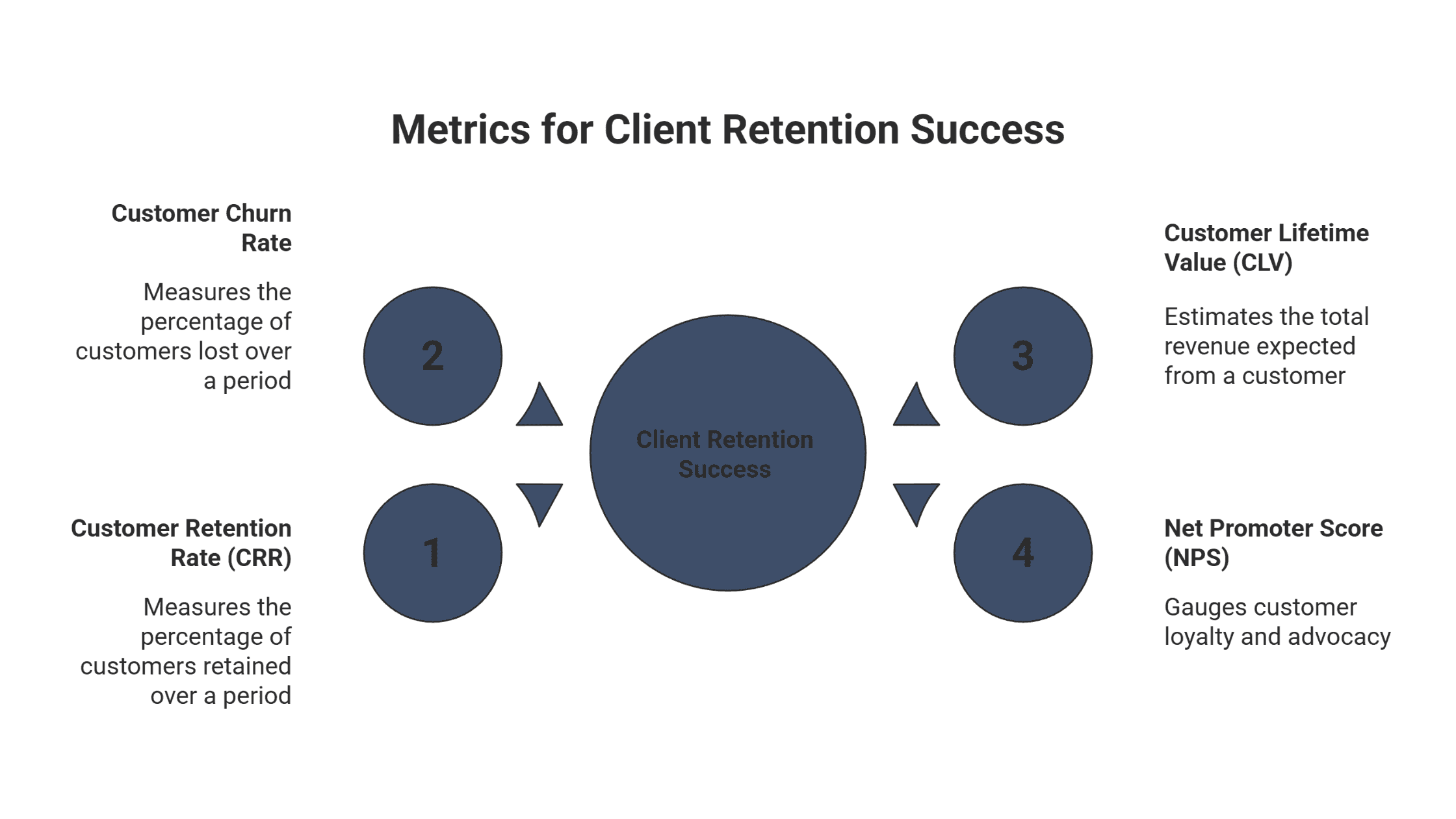
You can’t improve what you don’t measure. Focus on four essential metrics that predict retention success.
Customer Retention Rate (CRR)
Calculate retention rate by taking customers at period end, subtracting new customers acquired, then dividing by customers at period start and multiplying by 100. Professional services and local B2B providers typically achieveretention rates of 83-85%. Business consulting hits 85% while IT and managed services reach 83%. Track your CRR monthly and quarterly to spot trends early.
Customer Churn Rate
Churn measures how many customers you lose. Annual churn rates for professional services average 15-17%. Monitor churn by customer segment because high-value clients leaving hurts more than low-value departures.
Customer Lifetime Value (CLV)
CLV calculates total revenue you expect from a client throughout your relationship: Average Purchase Value × Purchase Frequency × Customer Lifespan. A client worth $50,000 over five years deserves different attention than one worth $5,000 over two years. Professional services firms aim to extend the average customer relationship beyond 3-5 years.
Net Promoter Score (NPS)
NPS measures customer loyalty by asking: “How likely are you to recommend us to others?” Service-based sectors average NPS scores of 68-80. Survey your clients quarterly to track trends and identify improvement opportunities.
Strategy 1: Design a Frictionless Onboarding Experience
Your onboarding process determines whether clients stay or leave. Get it right and you build momentum. Get it wrong and you fight an uphill battle for the entire relationship.
Why First Impressions Determine Long-Term Retention
An in-depth onboarding program can improve customer retention by 25%. This happens because onboarding sets expectations, demonstrates competence, and helps clients realize value quickly.86% of customers are more likely to remain loyal to brands that provide educational and welcoming onboarding content.
The first 30-90 days reveal whether you deliver on your promises. Clients form opinions about your responsiveness, professionalism, and ability to solve their problems. Poor onboarding creates immediate friction when clients don’t understand your processes, struggle to communicate with your team, or fail to see early results.
Implementation Steps for Effective Onboarding
Start with personalized welcome sequences that acknowledge each client’s specific goals. Generic “welcome aboard” emails feel impersonal and miss opportunities to reinforce why they chose your service.
Create clear onboarding checklists outlining what happens when. Build progressive disclosure into your process – don’t overwhelm new clients with everything at once. Onboarding processes utilizing user behavior data can boost retention rates by up to 50%.
Set up automated touchpoints triggered by time or behavior. Email clients at day 3, 7, 14, and 30 with helpful resources and progress updates. Assign clear ownership for onboarding success to ensure each client has a great start.
Strategy 2: Implement Proactive Customer Success Programs
Reactive support waits for clients to complain. Proactive success prevents problems before they escalate.
Moving from Reactive Support to Proactive Engagement
Most service businesses operate in reactive mode, responding when clients reach out but not initiating contact otherwise. Proactive engagement means consistently reaching out before issues arise, using automated messaging or scheduled check-ins to ensure satisfaction and preemptively solve problems.
For a marketing consultant like William O., this might involve monthly strategy reviews even when campaigns run smoothly, or quarterly audits that identify optimization opportunities before performance declines. Proactive approaches build trust; clients appreciate businesses that care enough to check in regularly.
How to Build a Customer Success Framework
Define clear success criteria with each client at the start. What does success look like? What metrics matter most? Collaborate with clients to define clear goals, then track progress using milestone checklists.
Use CRM data to segment clients based on lifecycle stage, behavior, or account value, then send customized communications suitable to each group. Schedule regular business reviews – quarterly meetings work well for most service relationships.
Collect client feedback through surveys or direct outreach, analyze it to identify friction points, and adapt processes accordingly. Establish systems like shared ticketing platforms to ensure fast responses to client queries.
Strategy 3: Leverage Data Analytics to Predict and Prevent Churn
Your client data reveals patterns that predict churn long before clients cancel. Learn to spot these signals and you can intervene early.
Identifying Early Warning Signs of Customer Attrition
Declining engagement represents the strongest predictor of churn. Track metrics like email open rates, login frequency, or service utilization. Sharp drops signal problems worth investigating. Communication pattern shifts serve as reliable early indicators: clients who stop responding promptly, skip scheduled calls, or engage less in meetings often prepare to leave.
Support friction reveals dissatisfaction before formal cancellation. Increased support tickets, negative feedback, or frustrated tone in communications all warrant immediate attention. Commercial signals like payment delays, contract non-renewal discussions, or budget cut mentions suggest clients questioning the relationship’s value.
Using AI and Predictive Models
Businesses leveraging AI for customized retention strategies achieve significantly lower churn rates. One telecommunications provider sawa 15% reduction in churn after introducing AI-driven behavioral clustering.71% of businesses currently use predictive analytics to reduce customer churn.
Leading platforms like ChurnZero, Gainsight, Totango, Custify, Catalyst, and ClientSuccess combine real-time health scoring with predictive modeling. Modern systems adjust client health scores continuously based on engagement, sentiment, and behavior patterns, then automatically trigger outreach when scores drop.
For service-based businesses, start simple: track 3-5 key engagement metrics in your CRM, set up alerts when metrics fall below thresholds, and build processes for responding within 24 hours.
Strategy 4: Personalize Every Customer Touchpoint
Generic communication fails because it ignores what makes each client unique. Personalization shows you understand and value individual needs.
Why Generic Communication Fails to Retain Clients
71% of consumers expect personalized interactions and 76% become frustrated when companies fail to deliver them. Clients immediately tell when you send template messages. Generic newsletters and one-size-fits-all service packages communicate that you don’t care enough to tailor your approach.
62% of business leaders report improved customer retention due to personalization efforts. Brands excelling at personalization are 71% more likely to report improved customer loyalty. The business case is clear: personalization can reduce customer retention costs by up to 28%.
Personalization Tactics That Scale
Move beyond demographic-based segmentation by targeting real-time behaviors and preferences. Track which services clients use most, what content they engage with, and which communication channels they prefer.
Set up automated emails triggered by client behavior such as appointment reminders, follow-up surveys after service completion, or relevant resource recommendations. AI-powered chatbots with personalization capabilities can deliver up to a 67% improvement in retention rates.
Leverage real-time context like location, time of day, or stage in the customer journey to personalize website content, appointment availability, or promotional offers. William & Friends builds these systems for service-based businesses, using CRM integrations and marketing automation to deliver personalized experiences at scale.
Strategy 5: Build and Activate Customer Communities
Peer-to-peer connection creates loyalty that transcends your direct relationship with clients.
The Power of Peer-to-Peer Connection
Customer communities transform clients into advocates who support each other, share best practices, and reinforce their commitment to your brand. Engaged community members are 37% more likely to remain loyal to a brand.
Communities provide value beyond what you can deliver directly. Clients learn from peers facing similar challenges, discover creative applications of your services, and build relationships that extend beyond vendor-customer dynamics. Communities also reduce support burden since members answer each other’s questions and troubleshoot common issues before contacting your team.
How to Launch and Grow a Thriving Customer Community
Start by understanding your clients’ needs through voice of customer data. What challenges do they want help solving? Define clear objectives for your community such as reducing churn, increasing product adoption, or generating referrals.
Choose platforms based on client preferences, not trends. Some audiences prefer private Facebook groups while others want dedicated forums or Slack channels. Create valuable content addressing genuine client needs through how-to guides, best practices, and member spotlights.
Build peer-to-peer support mechanisms by encouraging members to help each other and recognizing top contributors. Actively promote your community through email campaigns, in-product notifications, and direct invitations during onboarding.
Budget and Tools: Community platforms range from free to$350/month. Circle.so ($39-329/month),Mighty Networks ($33-99/month), or Facebook Groups (free) work well for small businesses. Expect 5-15 hours for setup and 2-6 hours weekly for ongoing moderation.
Strategy 6: Create Strategic Loyalty and Rewards Programs
Points systems alone won’t drive retention. Meaningful rewards that align with client values create lasting loyalty.
Beyond Points: Designing Meaningful Rewards
84-85% of consumers are more likely to stay with a brand offering a loyalty program. Loyalty programs drive 12-18% more incremental revenue growth per year from members compared to non-members.90% of loyalty programs report positive ROI, with an average return of 4.8x investment.
Traditional points-for-discounts programs miss opportunities to build emotional connections. Clients choose service providers based on trust, expertise, and results, not just price reductions. Focus on experiential rewards that create memorable moments; exclusive workshops, priority scheduling, dedicated account management, or special recognition events.
Loyalty Program Structures That Drive Retention
Design tiered programs with escalating benefits that reward long-term clients. Entry-level tiers provide basic perks while top tiers offer exclusive access and premium services.Nearly 70% of brands see increased engagement, and 58% see a rise in repeat purchases due to loyalty programs.
About 75% of members in high-performing loyalty programs change their buying behavior by purchasing more or engaging further with the business. Build dynamic, behavior-based programs that adapt rewards in real-time based on customer data and usage patterns.
Strategy 7: Deliver Continuous Value Through Customer Education
Educated clients understand your value, use your services more effectively, and stay longer.
Why Educated Customers Stay Longer
Structured customer education programs boost product adoption rates by an average of 38%, helping users unlock more features and deepen engagement. Companies report that customer education initiatives improve retention by 22% on average, and56% of organizations implementing education programs see increased customer retention.
In 2025, 96% of organizations with customer education programs recouped their investment, with 86% reporting positive ROI. A Forrester study found companies with formalized education programs achieved 7.4% higher retention compared to peers without such initiatives.
Content and Training Programs That Increase Product Adoption
Develop structured onboarding programs including step-by-step guides, interactive tutorials, and videos. Offer live interactive training through webinars that allow real-time engagement and Q&A.
Create self-paced on-demand courses and searchable knowledge bases that support flexible learning. Build certification and progress tracking into your education program. Structured certifications offer tangible recognition of achieved competencies, boosting engagement and retention.
Providing documentation and video tutorials helps clients master products independently and reduces reliance on reactive support. This self-service approach scales efficiently while maintaining educational value.
Real-World Service Business Retention Success Stories
MJ Anderson & Company: HVAC Service Excellence
MJ Anderson & Company, a regional HVAC service provider with 50-100 employees, focused on exceptional residential service and long-term relationship building. They implemented proactive maintenance plans, personalized communication, and loyalty rewards for repeat customers, achievinga 98.8% client retention rate within 12-18 months.
The strategy required significant investment in staff training and CRM systems to track customer interactions and personalize service. Initial resistance from technicians to adopt new communication protocols posed challenges, but the results proved the investment worthwhile.
Sweet Fish Media: B2B Churn Reduction
Sweet Fish Media, a small B2B podcasting agency with 10-20 employees, implemented a churn prevention strategy with clear goals, quarterly podcast reviews, and direct client consultations. Account managers began consulting clients on best practices and reviewing client success quarterly,reducing monthly churn from 15% to 3% in less than a year.
The strategy required a cultural shift to prioritize client feedback and proactive engagement. Some clients initially saw reviews as unnecessary, requiring education on value, but the dramatic churn reduction validated the approach.
ICON: Feedback-Driven B2B Success
ICON, a mid-sized B2B outsourcing solutions provider with 100-200 employees, introduced twice-yearly relationship surveys with a closed-loop feedback system. Customers with issues were invited to join a 90-day action plan to resolve concerns, with local “experience champions” empowered to act on feedback. The company achieveda 98.8% retention rate and 100% survey response rate within 18 months.
The program required significant internal coordination and training for account managers. Some customers were initially skeptical about the value of surveys, but consistent follow-through on feedback built trust.
HVAC Supply Superstore: Predictive LTV Modeling
HVAC Supply Superstore, a large regional e-commerce superstore with 200+ employees, partnered with AdZeta to implement predictive lifetime value modeling and value-based bidding for digital ads. Focusing on acquiring and retaining high-value professional contractors, they achieveda 3.8x increase in contractor retention and 45% reduction in customer acquisition cost for high-value segments within 12-18 months. Marketing ROI increased by 320%.
The strategy required integration of new AI-driven analytics tools and a shift from traditional CPA-based marketing to LTV-focused strategies. Initial resistance from the marketing team to change established practices slowed implementation.
HeidelbergCement: Property Maintenance Follow-Up
HeidelbergCement, a large regional property maintenance provider operating as a network of local teams, implemented regular customer follow-up calls for detractors and passives, with personalized action plans. Local champions empowered to act on feedback achievedover 70% survey response rates and significantly improved retention and loyalty within 12 months.
The program required significant investment in training and CRM systems. Some local teams initially resisted the new feedback-driven approach, but visible improvements in customer satisfaction convinced skeptics.
Top Implementation Challenges for Small Service Businesses
Small service businesses face distinct obstacles when implementing retention strategies. Understanding these challenges helps you plan realistically and avoid common pitfalls.
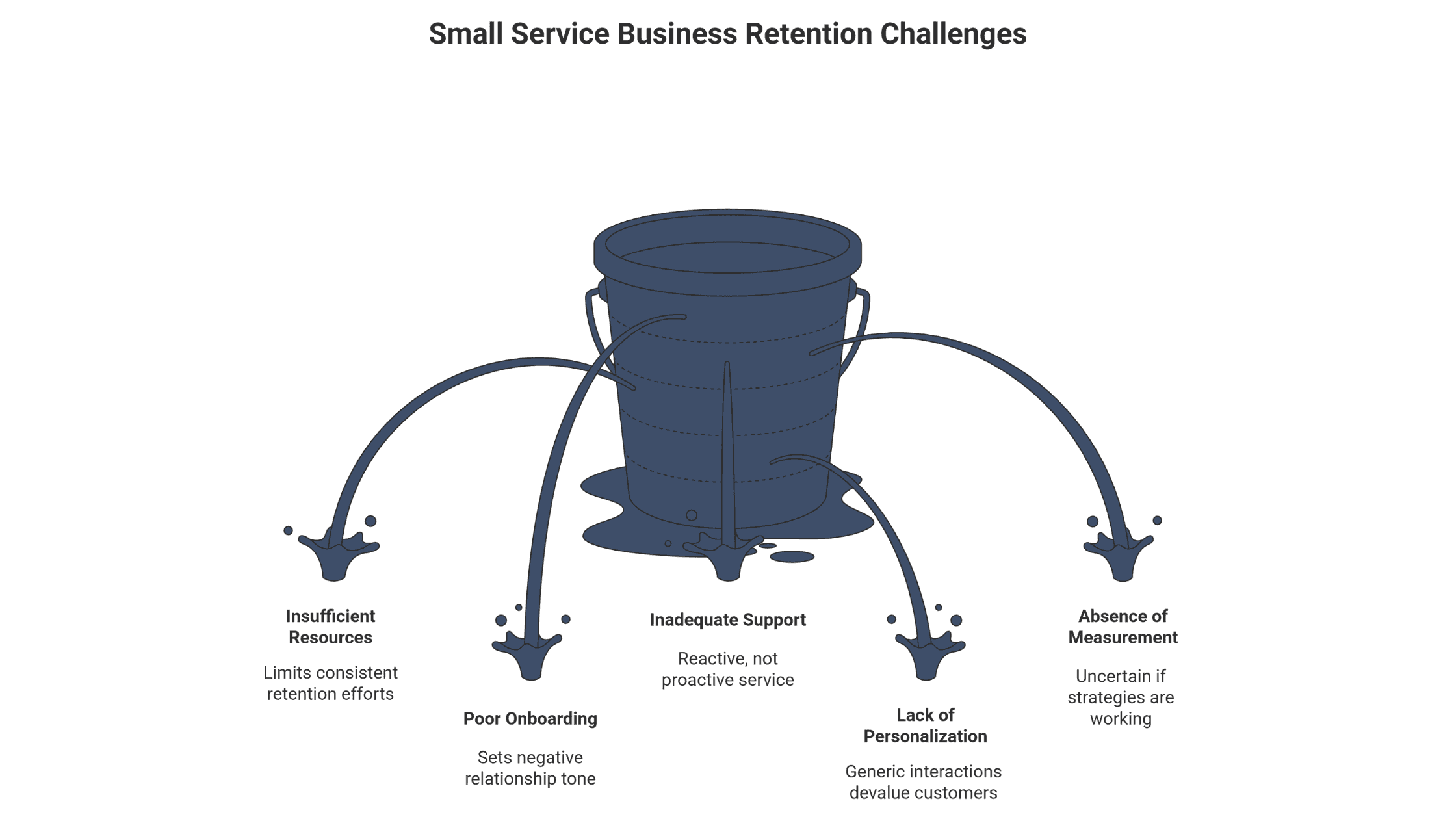
Challenge 1: Insufficient Resources and Inconsistent Execution
Small service businesses often lack the time, budget, and personnel to maintain consistent retention efforts. While larger companies have dedicated retention teams, service business owners juggle multiple roles simultaneously. When follow-up communications don’t happen systematically (no regular emails, phone calls, or surveys), the entire burden falls on customers to maintain the relationship. Service businesses that haven’t formalized retention processes typically see customers drift away due to neglect rather than dissatisfaction.
Solution: Streamline your approach by focusing on one or two high-impact retention tactics rather than trying to implement everything at once. Many successful small service businesses start with a simple quarterly check-in system and basic loyalty recognition before expanding efforts. Use affordable CRM tools to automate reminders and set clear expectations about who owns customer follow-up.
Challenge 2: Poor Onboarding and Inconsistent Service Delivery
New customers in service businesses often experience friction during onboarding, which sets a negative tone for the entire relationship. The onboarding experience involves human interactions across multiple touchpoints: initial consultation, contract signing, first service delivery, and communication protocols. When onboarding processes aren’t streamlined, customers face confusion about procedures, billing, or expectations.
Inconsistent service delivery across team members undermines retention efforts. If one staff member provides excellent service while another delivers mediocre experiences, customers lose confidence in your business.
Solution: Create a documented onboarding checklist that every team member follows. This should include clear communication of expectations, introduction to team members, explanation of service protocols, and confirmation of preferred contact methods. Make simplicity your priority; reduce unnecessary steps and ensure customers understand how to work with you from day one.
Challenge 3: Inadequate or Reactive Customer Support
More than 60% of consumers now have higher customer service standards. For small service businesses, this is complicated by limited staff availability. Many try to operate with reactive support only, responding when customers complain rather than proactive service.
Service businesses often don’t provide support across customer-preferred channels. A customer might prefer email communication, but your business only responds during business hours via phone. Support team members often lack adequate training, causing inconsistent problem resolution.
Solution: Identify the top 2-3 communication channels your customers actually use, then commit to consistent responses through those channels. Set specific response time targets (for example, within 24 hours for emails). Invest in basic training for your team on product knowledge and empathy-based problem-solving.
Challenge 4: Lack of Personalization and Forgotten Preferences
Service business customers expect personalized experiences, yet many small businesses fail to capture and remember customer preferences, communication history, or specific needs. When each interaction feels generic or when customers must re-explain their situation repeatedly, they perceive your business as not valuing them.
Solution: Use even simple systems to document customer preferences. A spreadsheet noting how each customer prefers to be contacted, what services they’ve used previously, and any special requirements goes a long way. Train staff to actively listen for preferences and add them to customer records. Small touches (remembering a customer mentioned they prefer morning appointments) build loyalty disproportionately.
Challenge 5: Absence of Measurement and Data-Driven Adjustments
Many small service businesses implement retention strategies without measuring results, leaving them uncertain about what’s actually working. Without tracking key metrics, they can’t identify which customer segments are at highest risk or which interventions move the needle. Retention strategies fail silently when there’s no measurement system.
Solution: Start tracking three essential metrics: turnover rate (clients lost per period divided by total clients), which customer segments have the highest attrition, and timing patterns in when customers typically leave. Set a quarterly review process to analyze this data and identify one specific improvement. You don’t need sophisticated software; a spreadsheet tracking customer start and end dates can reveal patterns.
The core insight for small service businesses is that retention doesn’t require expensive enterprise solutions. It requires consistency, systematic follow-up, and genuine attention to customer experience.
Building Your Client Retention Action Plan
Prioritizing Strategies Based on Your Business Model
Your business model determines which retention strategies deliver the highest return. B2B service providers benefit most from account-based retention with dedicated management, proactive check-ins, and deep personalization for key accounts. Subscription-based services should prioritize health scoring and churn risk models. Transactional service businesses focus on experience improvements and scalable personalization.
Start by mapping your current retention rates against industry benchmarks. If you’re significantly belowthe 83-85% standard for professional services, you have clear opportunity for improvement. Identify your biggest churn drivers through client exit interviews and data analysis. Do clients leave due to poor communication, service quality issues, or better competitive offers?
Quick Wins vs. Long-Term Retention Investments
Quick wins deliver measurable improvements within 30-90 days. Implement automated check-in emails triggered at key milestones. Improve your onboarding materials by creating simple checklists that guide new clients through their first month. Launch a basic NPS survey to understand current satisfaction levels and identify promoters worth engaging for referrals.
Long-term investments build sustainable retention infrastructure over 6-12 months. Develop comprehensive customer education programs including workshops, documentation, and certification tracks. Build or upgrade your CRM system to monitor engagement signals, detect churn risks, and trigger automated outreach. Create formal customer success playbooks documenting how your team should engage clients at each lifecycle stage.
William & Friends helps service-based businesses build these systems through tailored consulting that addresses your specific retention challenges. Our approach focuses on creating predictable, measurable improvements in client relationships.
Conclusion
The path to increase client retention starts with understanding that keeping clients costs far less than finding new ones while delivering significantly higher lifetime value. Service-based businesses that master retention build predictable revenue streams, reduce marketing costs, and create sustainable competitive advantages through loyal client relationships.
The seven strategies covered here work because they address retention systematically: frictionless onboarding sets the foundation, proactive success programs prevent issues before they escalate, data analytics predicts problems early, personalization shows you care about individual needs, communities build peer connections, loyalty programs reward long-term relationships, and education helps clients maximize value.
William & Friends applies these retention principles every day in our work with service-based businesses across home services, commercial providers, and local B2B firms. We build marketing systems that don’t just acquire clients but keep them engaged through data-driven personalization, proactive communication, and continuous value delivery.
Start by measuring your current retention metrics honestly. Calculate your CRR, churn rate, CLV, and NPS to establish a baseline. Identify which strategies align best with your business model and resources, then implement systematically rather than trying everything at once.
Quick wins like improved onboarding and automated check-ins deliver near-term results while you build long-term infrastructure through customer success programs, data systems, and education initiatives. The businesses that win in 2026 will be those that treat retention as seriously as they treat acquisition.
Ready for predictable growth built on strong client relationships?Talk to William & Friends about building retention systems that actually work for your service-based business.
