How to Rank on Google Maps: 11 Proven Steps
Learn how to rank on Google Maps with 11 proven strategies. Optimize your Google Business Profile, boost local SEO, and dominate local search results today!

William Turner
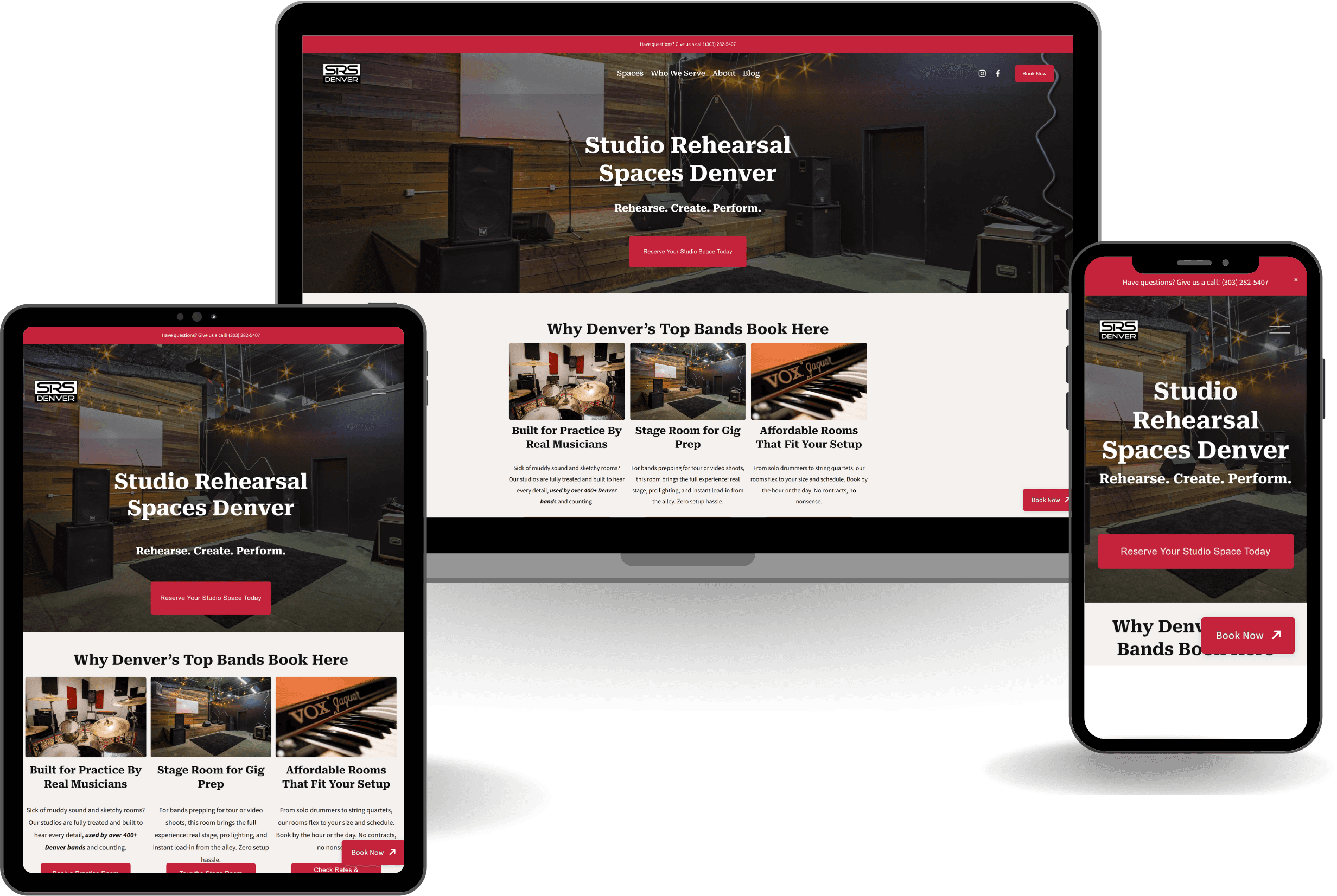
Hey, I’m William, founder of William & Friends in Denver. We help service businesses get found, get chosen, and get booked. SEO, CRO, and ads tied to clean reporting. Recent wins include 908% year-over-year traffic for a commercial laundry brand and 39% more revenue attributed to organic search for a Denver studio. I write about conversion math, offer-to-channel fit, and operator-grade marketing. If you want the truth about where your pipeline leaks, grab the free marketing audit.
Dec 8, 2025
8
Learning how to rank on Google Maps can completely change your service business's visibility and how many leads you get. When 88% of consumers use Google Maps to find local businesses and 42% of local searchers click on Map Pack results, where you show up in those rankings directly affects your revenue. At William & Friends, we help service-based businesses build predictable growth systems through local SEO strategies that generate qualified leads instead of just traffic.
TL;DR: How to Rank on Google Maps
Claim and fully optimize your Google Business Profile with accurate NAP information, relevant categories, and high-quality photos. Build consistent authentic reviews while keeping NAP data the same across all directories. Create location-specific website content with local schema markup, publish regular Google Posts, and embed your map on your site. Build local citations in industry directories and earn community-based backlinks. Track performance using local search visibility tools and adjust based on what the data tells you. Google ranks businesses on how close they are to searchers, how relevant they are to search intent, and prominence signals like reviews and backlinks.
Key Points
Google Maps dominance drives real business results: Local searches convert at 28%, and 88% of mobile local searches result in same-day action
Profile completeness matters: Businesses with complete Google Business Profiles are 70% more likely to attract visits and 50% more likely to be considered for purchase
Reviews directly impact rankings: Google looks at both how many reviews you have and their quality as prominence signals
NAP consistency builds trust: Businesses with consistent name, address, and phone data across directories are 40% more likely to appear in the local pack
Visual content drives engagement: Listings with photos get 42% more direction requests and 35% more website clicks
Why Ranking on Google Maps Matters for Your Business
Your position on Google Maps determines whether potential customers find you or your competitors. With 80% of U.S. consumers searching for local businesses weekly and 32% searching daily, visibility in the local map pack creates a predictable pipeline of qualified leads.
The map pack captures most local search clicks. When 42% of local searchers choose one of these top three positions, being outside that group means you're missing nearly half your potential customers. For service businesses, this translates directly to lost revenue.
Mobile behavior makes this even more important. Nearly 76% of "near me" searches lead to a business visit within 24 hours, creating immediate conversion opportunities.
How Google Ranks Businesses on Google Maps
Google's algorithm looks at three core factors: proximity, relevance, and prominence. Local SEO expert Joy Hawkins notes that "the proximity factor has changed a lot, it's way more important than it used to be" while "prominence is increased" and "the one that's decreased is relevance."
Proximity: Distance from the Searcher
Google prioritizes businesses physically closer to where someone is searching. You can't change your address, but you can optimize for service area visibility through strategic location page creation and accurate service radius settings in your profile.
Relevance: Matching Search Intent
Relevance measures how well your business matches what searchers want. Google analyzes your business categories, description, services, and website content to figure out if you're a good fit. Choosing the most specific primary category (like "House Cleaning Service" instead of generic "Cleaning Service") improves relevance signals.
Prominence: Authority and Popularity Signals
Prominence reflects your business's authority and reputation. Research shows that reviews with actual text had a stronger impact on rankings, with Google relying on review content to understand what a business offers. Combined with backlink profiles, citation consistency, and overall online visibility, these signals reward businesses that deliver consistent value and build real relationships.
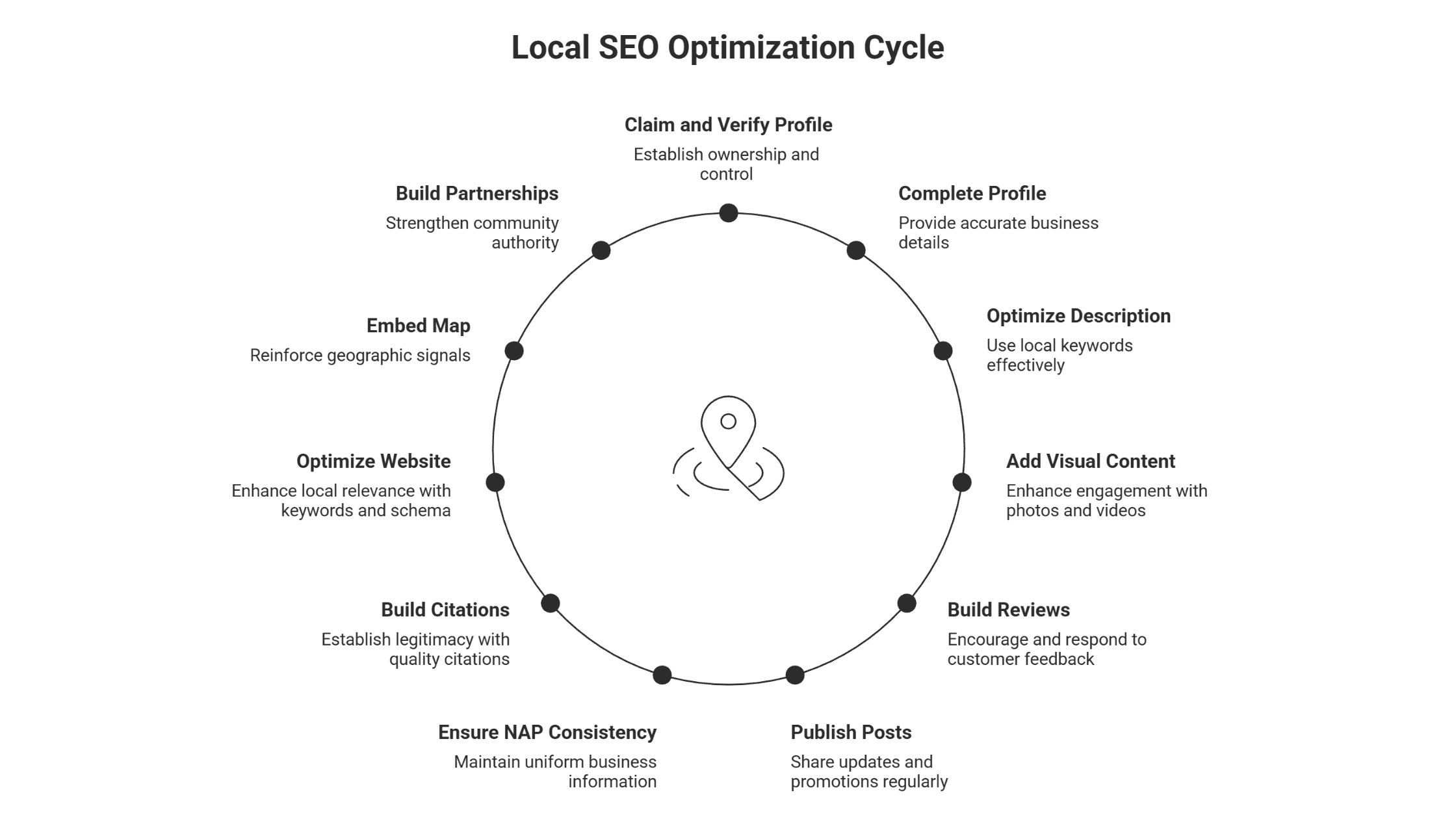
Step 1: Claim and Verify Your Google Business Profile
Your Google Business Profile is the foundation for all maps SEO efforts. Without a claimed and verified listing, you can't control key information or access optimization features that influence rankings.
Search your exact business name in Google Maps to find your existing listing. If it doesn't exist or someone else created it, visit google.com/business and add your business details including name, address, phone number, category, and hours. Service area businesses operating from home can hide their address while showing service areas.
Google requires verification to confirm ownership. Most businesses receive a verification postcard at their listed address within 5-7 days containing a code. Some qualify for instant verification via phone or email. Complete this step right away (unverified profiles get limited visibility).
Step 2: Complete Your Google Business Profile with Accurate Information
Profile completeness directly impacts visibility and conversion. Fully completed profiles generate 4× more website visits, 12% more calls, and 10% more direction requests.
Essential Business Information (NAP, Hours, Categories)
Your name, address, and phone number must match exactly across every online platform. Minor variations like "Street" versus "St." or different phone formatting confuse Google's verification systems and split your ranking authority.
Set accurate business hours including special hours for holidays. Update these proactively rather than leaving customers frustrated.
Choosing the Right Primary and Secondary Categories
Your primary category carries the most weight for ranking. Select the most specific option available. According to Joy Hawkins' research, "keywords in business name, categories, reviews and which pages you link to on your web site" rank among the top local factors.
A precision auto repair shop that added non-compliant keywords to their business name saw immediate ranking drops. Within 14 days of correction, rankings recovered. This shows how critical proper category selection and naming compliance are (violations trigger penalties, while fixes restore visibility quickly).
For plumbing contractors, choose "Plumber" or "Plumbing Contractor" instead of generic "Contractor." Add relevant secondary categories (up to nine total) that represent actual services you provide. Don't stuff categories (Google's algorithms detect this and may penalize your profile).
Step 3: Optimize Your Business Description with Local Keywords
Your business description should combine compelling copywriting with strategic local keywords. Front-load the first 250 characters with your primary service and location since this section displays before the "Read More" cutoff.
Describe what makes your service business different while naturally working in terms customers search. A commercial cleaning company might write: "Professional commercial cleaning services for Denver office buildings and retail spaces. We provide nightly janitorial services, floor care, and disinfection programs for businesses throughout the Denver metro area."
Write conversationally while working in neighborhoods, service types, and relevant search terms. Skip keyword stuffing or robotic-sounding descriptions.
Step 4: Add High-Quality Photos and Videos
Visual content dramatically influences customer engagement. Businesses with photos receive 42% more direction requests and 35% more website clicks.
Upload photos showcasing your team, completed work, equipment, and workspace. Service businesses benefit from before-and-after project photos, team members in action, and satisfied customers (with permission). Video content drives 41% higher click-through rates than text-only pages, with Google now auto-playing some videos in the second image position on mobile.
Top-ranking businesses maintain 250+ photos on average. Upload at least 15 recent, high-quality images to signal an active business. Add new photos monthly and encourage satisfied customers to upload their own, as user-generated content adds authenticity.
Step 5: Build a Steady Stream of Google Reviews
Reviews function as both a ranking signal and conversion factor. Google explicitly considers review quantity and quality when determining local pack rankings.
Creating a Review Generation Strategy
Build review requests into your service delivery process. Send follow-up messages 2-3 days after project completion when satisfaction is highest. Provide direct links to your review page to reduce friction.
I Cleaning Services implemented systematic review generation as part of their Google Business Profile optimization. By focusing on generating frequent, specific reviews mentioning keywords like "residential cleaning" and targeted neighborhoods, they achieved a 44.4% improvement in average Google Maps ranking for their primary search term within 25 days. Phone calls increased by 12.6%, with a noticeable uptick in new customer inquiries.
The key was consistency paired with encouraging detailed, keyword-rich reviews rather than simple star ratings. Focus on making the review process simple and requesting feedback when customers are naturally satisfied. Don't incentivize reviews with discounts or payments (this violates Google's policies).
Responding to Reviews (Positive and Negative)
Respond to reviews within 24 hours whenever possible. Thank customers for positive feedback and address specific points they mentioned. For negative reviews, stay professional and solution-focused. Offer to resolve issues offline while demonstrating to future customers how you handle problems.
Review Velocity and Quality Matters
Summit Physical Therapy closed competitive gaps by increasing Google Business Profile posting frequency to three times weekly while actively encouraging clients to leave detailed, keyword-rich reviews. Combined with optimizing their GBP Q&A section and uploading new photos weekly, they climbed from #5 to top 3 in the Map Pack within 8 weeks, surpassing competitors using advanced tactics. This shows that consistent, quality review generation paired with active profile management delivers measurable ranking improvements faster than sporadic efforts.
Step 6: Publish Regular Google Posts
Google Posts keep your profile active and provide opportunities to highlight current promotions, events, and updates. Regular posting signals an actively managed business to both Google and customers.
Use update posts for general announcements, event posts for time-sensitive activities, and offer posts to highlight specific promotions with clear calls-to-action. Share helpful tips related to your services, highlight community involvement, and include clear calls-to-action with booking links or phone numbers.
Step 7: Ensure NAP Consistency Across the Web
NAP inconsistency ranks among the most damaging ranking issues. Minor variations that seem insignificant (such as "Street" versus "St." or formatting phone numbers differently) create major algorithmic confusion. Research shows NAP inconsistency can impact site performance by as much as 16%.
Auditing Your Current Citations
Search your business name and city in Google to identify existing listings. Check major directories like Yelp, Facebook, Bing Places, and Apple Maps. Document variations in how your business information appears across platforms, including using "LLC" or "Inc." inconsistently, different suite numbers, or phone number formatting variations.
Fixing Inconsistencies and Duplicate Listings
Update every listing to match your Google Business Profile exactly. Claim listings where possible or contact directory managers to request corrections.
Duplicate Google Business Profile listings divide your reviews, impressions, and authority across separate profiles, confusing both Google's algorithms and potential customers. This results in ranking penalties or suspension. Search your business name and address directly in Google Maps to identify all existing listings. Use the "Suggest an edit" feature to flag duplicates for removal, or contact Google support directly. Make sure only one verified profile exists per physical location and maintain secure ownership to prevent future duplicates from staff members or third-party agencies.
Businesses that corrected NAP inconsistencies saw 37% increases in local search visibility according to documented case studies.
Step 8: Build High-Quality Local Citations
Local citations establish your business's legitimacy and geographic relevance across the web. Quality matters more than quantity (focus on authoritative platforms that strengthen your industry credibility).
Top Citation Sources for Local Businesses
Start with universal platforms: Google Business Profile, Apple Maps, Bing Places, Facebook, and Yelp form the foundational layer. These platforms feed data to numerous other services, multiplying the impact of accurate listings. Use data aggregators like ExpressUpdate and Localeze that distribute your information to hundreds of smaller directories efficiently.
Industry-Specific Directories
All-Star Roofing demonstrates citation-building's power after business relocation. After moving their Denver operation, they aggressively built new local citations reflecting the address change (ensuring consistent NAP across all platforms). They launched a review generation campaign encouraging customers to mention the new service area in review text, responded to each review to increase engagement, and used GBP posts to announce the relocation. Within 90 days, rankings transitioned from positions #19 downtown and #16 for "roofer Denver" to #6 in their new local area, with lead volume fully recovering in the new location.
Service businesses should prioritize directories relevant to their specific trade. Home service contractors benefit from listings on Angi, Houzz, and Better Business Bureau. Join trade associations that maintain member directories (organizations like the Plumbing-Heating-Cooling Contractors Association offer valuable directory listings plus professional credibility). Local Chamber of Commerce directories strengthen community connections while providing authoritative local backlinks.
Step 9: Optimize Your Website for Local Search
Your website reinforces the local relevance signals sent by your Google Business Profile.
Adding Location Pages and Local Keywords
Create dedicated pages for each city or region you serve with unique content describing services in that specific area (not duplicate content with only the city name changed). Work local keywords naturally throughout your site, including city names, neighborhood references, and regional landmarks.
Implementing Local Schema Markup
Local business schema provides structured data that helps search engines understand your business details. This JSON-LD code should include your business name, address, phone number, hours, and service areas. Here's an example for a plumbing service:
{
"@context": "https://schema.org",
"@type": "Plumber",
"name": "Smith Plumbing",
"address": {
"@type": "PostalAddress",
"streetAddress": "123 Main Street",
"addressLocality": "Denver",
"addressRegion": "CO",
"postalCode": "80202"
},
"telephone": "+1-303-555-0123",
"openingHours": "Mo-Fr 08:00-17:00",
"areaServed": ["Denver", "Aurora", "Lakewood"]
}
Schema markup doesn't directly boost rankings but improves how search engines interpret your content. Use Google's Schema Markup Validator to ensure proper implementation.
Ensuring Mobile Responsiveness
Mobile users conduct the majority of local searches with immediate intent. Your website must load quickly and display properly on smartphones. Test your site using Google's Mobile-Friendly Test tool and address any issues, as slow-loading or difficult-to-navigate mobile sites increase bounce rates.
Step 10: Embed Your Google Map on Your Website
Embedding your Google Map on your website's contact or location page reinforces geographic signals to search engines while creating a seamless user experience. Place the embedded map prominently on your contact page or footer, making sure it links to your verified Google Business Profile rather than showing a generic location pin.
Step 11: Build Local Links and Partnerships
Local backlinks signal community authority and strengthen your prominence ranking factor. Focus on earning genuine links from neighborhood websites, local media, and community organizations.
Local Link Building Strategies
Cascade Plumbing recovered from a Google core update ranking drop through strategic link building. After their Seattle ranking plummeted from #3 to #12 for "plumber Seattle," they launched new service-focused content, improved on-page optimization, and invested in targeted local link building. Combined with review generation and updating their Google Business Profile with high-quality photos, their Maps ranking recovered to #3 within 60 days. Revenue grew to 20% above previous baseline, with weekly calls increasing from 8 to over 50.
Partner with other local businesses for mutual promotion opportunities. A cleaning service might collaborate with real estate agents, property managers, or moving companies for reciprocal referrals and website links. Sponsor local events, sports teams, or charity organizations (sponsorships often include website recognition with backlinks from event pages).
Pitch stories to local newspapers, magazines, and neighborhood blogs. Media coverage provides authoritative backlinks while building brand awareness. Focus on newsworthy angles like business milestones, community involvement, or unique service offerings.
Leveraging Community Relationships
Create locally-focused content that naturally attracts links. Write guides to your city, neighborhood spotlights, or local industry resources that other websites want to reference. Get listed in local business roundups, "best of" lists, and directory features. These editorial mentions from local publications carry significant authority value.
Tracking Your Google Maps Ranking Performance
Measuring your progress enables data-driven optimization decisions. Track metrics that directly correlate with business outcomes rather than vanity numbers that don't impact revenue.
Key Metrics to Monitor
Monitor your ranking position for target local keywords in your service area. Track how often your business appears in the map pack versus organic results. Use grid tracking to understand ranking variations across different neighborhoods you serve.
Measure Google Business Profile insights including search views, map views, and customer actions. Track phone calls, direction requests, and website clicks generated from your profile. Review your competitor positions regularly to identify optimization opportunities you've missed.
Tools for Measuring Local Search Visibility
Google Business Profile Insights provides basic performance data directly in your dashboard showing search queries triggering your profile, customer actions, and photo performance. Third-party local SEO tools offer more comprehensive tracking including competitor monitoring, citation management, and review tracking.
Set up regular reporting intervals to spot trends rather than reacting to daily fluctuations. Focus on long-term directional progress.
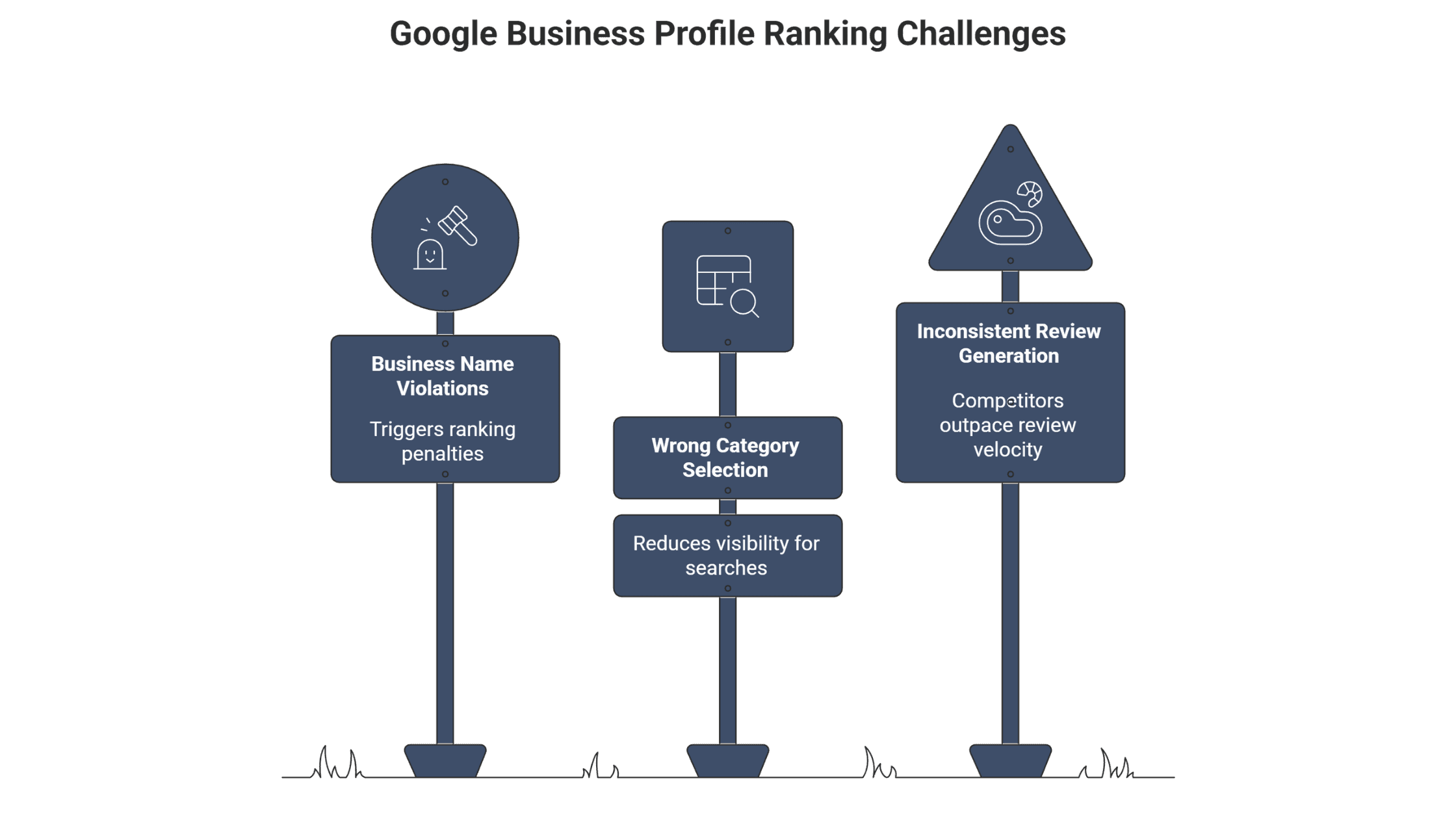
Common Mistakes That Kill Google Maps Rankings
Business Name Violations Trigger Immediate Penalties
Adding keywords, locations, or service descriptions to your business name violates policies and triggers immediate ranking penalties or profile suspensions. "Smith Plumbing" is correct; "Smith Plumbing Denver | Emergency Repairs" will get flagged. Review your current business name in Google Business Profile and compare it to your legal business registration documents. Remove any keywords, locations, or descriptive language that doesn't appear in your official registration.
Wrong Category Selection Causes Ranking Drops
Your primary category ranks among the top three ranking factors. Selecting overly broad categories reduces visibility for specific searches, and unnecessary changes signal instability to Google. A documented case showed a business dropping from #4 to #18 after switching to an incorrect primary category, then recovering to #5 within 14 days after correction. Identify your core service and select the most precise primary category available. Research what top competitors use and only add secondary categories for services you genuinely offer.
Inconsistent Review Generation Patterns
If competitors generate reviews faster than you, you'll slide down in rankings even if your overall quality is strong. Google measures review velocity (consistent flow over time), recency (recent reviews carry more weight), and diversity (photo reviews and keyword mentions). Establish a systematic process to request reviews from satisfied customers immediately after service completion. Monitor your review rate compared to top competitors and increase outreach efforts if you're falling behind.
Best Tips to Rank Higher on Google Maps for Service-Based Businesses
Upload 15+ High-Quality Photos Monthly: Businesses ranking in top positions maintain 250+ images on average. Showcase completed projects, your team, and equipment regularly.
Create Service-Specific Content on Your Website: Dedicated pages for each major service help rank for more specific searches. "Emergency drain cleaning" and "water heater installation" deserve separate pages with unique content.
Build Systematic Review Generation: Integrate review requests into your service completion process rather than asking sporadically. Consistent reviews over time outperform sudden spikes that look suspicious.
Respond to Every Review Within 24 Hours: This signals active management and builds customer trust. Personalize responses with specific details from each review rather than copying generic templates.
Frequently Asked Questions About Ranking on Google Maps
How long does it take to rank on Google Maps?
Most businesses see initial movement within 4-8 weeks of optimizing their Google Business Profile and fixing basic issues. Significant improvements typically require 3-6 months of consistent effort. The case studies show varied timelines: I Cleaning Services saw results in 25 days, Cascade Plumbing recovered in 60 days, and All-Star Roofing needed 90 days after relocation. Competitive markets need longer timelines.
Can I rank on Google Maps without a physical address?
Service area businesses operating from home can hide their address while still ranking in target service areas. Set your service radius appropriately and optimize for the locations you serve through website location pages and localized content.
How many reviews do I need to rank well on Google Maps?
Review quantity matters, but quality and consistency matter more. Aim for at least 10-15 reviews to establish credibility, then focus on generating 2-5 new reviews monthly. Competitive industries may require 50+ reviews to rank in the top three positions.
Does Google Maps ranking differ from regular Google search ranking?
Yes, map pack rankings use different algorithms emphasizing proximity, Google Business Profile optimization, and local citations. Regular organic search rankings focus more on website authority, content quality, and backlinks. You need strategies for both to maximize local visibility.
What should I do if my Google Business Profile gets suspended?
Review Google's policy guidelines to identify potential violations. Common causes include incorrect business name, ineligible business type, or suspicious review patterns. Fix any policy violations, then submit an appeal through the Google Business Profile dashboard with evidence of compliance. Most appeals get decisions within 2-4 weeks.
How does William & Friends help with Google Maps ranking?
William & Friends specializes in building predictable lead generation systems for service-based businesses through comprehensive local SEO strategies. We handle Google Business Profile setup, citation management, review generation systems, and website optimization while integrating everything into your broader marketing operations. We focus on sustainable growth rather than quick fixes.
Conclusion
Ranking on Google Maps requires building systematic processes rather than chasing individual tactics. Complete profile optimization, consistent review generation, NAP accuracy, and strategic content creation work together to improve visibility predictably.
Service businesses achieving sustainable rankings treat local SEO as an operating system, not a one-time project. They monitor metrics consistently, adapt strategies based on real data, and integrate optimization efforts with broader business operations. The case studies show that focused, consistent implementation across 25-90 days delivers measurable results: ranking improvements, increased calls, and revenue growth.
William & Friends helps service-based businesses build these revenue-driving systems through operator-minded strategies that prioritize measurable results over theory. Ready for predictable growth? Talk to William & Friends about building a local search system that delivers the leads your service business needs.
Frequently asked questions
William Turner
Hey, I’m William, founder of William & Friends in Denver. We help service businesses get found, get chosen, and get booked. SEO, CRO, and ads tied to clean reporting. Recent wins include 908% year-over-year traffic for a commercial laundry brand and 39% more revenue attributed to organic search for a Denver studio. I write about conversion math, offer-to-channel fit, and operator-grade marketing. If you want the truth about where your pipeline leaks, grab the free marketing audit.
Hey, I’m William, founder of William & Friends in Denver. We help service businesses get found, get chosen, and get booked. SEO, CRO, and ads tied to clean reporting. Recent wins include 908% year-over-year traffic for a commercial laundry brand and 39% more revenue attributed to organic search for a Denver studio. I write about conversion math, offer-to-channel fit, and operator-grade marketing. If you want the truth about where your pipeline leaks, grab the free marketing audit.
Success Studies
Growth Happens Here
See how our strategies have helped clients dominate their markets: