Marketing for Therapists: Get More of the RIGHT Clients
Discover proven marketing for therapists strategies that drive client growth . Get actionable tips to build your practice and attract more clients today.

William Turner
Founder, William & Friends
Mar 2, 2026
8

Marketing for therapists isn't optional anymore—it's how you keep your caseload full and your practice growing. The mental health landscape has fundamentally shifted: total behavioral health visits reached 66.4 million in 2024, surpassing primary care for the first time, while the U.S. behavioral health market is projected to grow from $101.84 billion in 2026 to $159.35 billion by 2035. That's massive demand, but it also means more competition for clients who increasingly find providers online rather than through traditional referrals.
At William & Friends, we build full-stack revenue engines for service-based businesses, and therapy practices face the same growth challenges as any other service provider: you need predictable lead generation, clear positioning, and marketing systems that actually convert inquiries into booked sessions. The difference? You're navigating HIPAA compliance, ethical boundaries, and a client base that's often anxious about reaching out in the first place. This guide draws from our work with therapy practices and healthcare providers who've successfully built systematic client acquisition, respecting professional realities while filling schedules with ideal clients who align with their therapeutic niche.
Therapists who want consistent growth in 2026 need to stop treating marketing as an afterthought and start building it as a system. Focus first on defining a clear therapeutic niche and positioning, then establish your online foundation through a conversion-optimized website, Google Business Profile, and key therapy directories like Psychology Today and Zocdoc. Local SEO and educational content build long-term authority, while strategic paid advertising (Google Search for high-intent queries, modest social spend for retargeting) can accelerate results when your conversion funnel works. Professional referral networks and compliant email nurturing sustain growth over time, but everything breaks if you ignore HIPAA requirements, ethical boundaries, and basic tracking to measure what's actually bringing in clients.
Key Points
Define your niche tightly—therapists who market "anxiety and depression for adults" disappear in search results, while those focused on "EMDR for new parents with birth trauma in Denver" attract aligned, ready-to-book clients who recognize themselves in your messaging.
Your Google Business Profile is your most important free marketing tool—optimize it as a service-area business, use your most specific category, upload current photos of you and your space, and systematically ask satisfied clients for reviews to dominate local map pack results.
Content marketing builds trust faster than ads for therapy services—prospective clients are evaluating whether they can trust you with their mental health, so monthly blog posts that answer real client questions (written in plain language, not clinical jargon) do more for long-term acquisition than generic "anxiety therapy near me" ads.
Paid ads work best when you already convert inquiries well—industry data shows psychiatry converting at ~75.6% from prospect to patient, among the highest in medical specialties. If your practice converts below 60%, fix your intake process and website clarity before spending money driving more traffic into a leaky funnel.
HIPAA compliance isn't negotiable in digital marketing—you cannot use standard Google Analytics, Facebook Pixel, or email platforms without Business Associate Agreements and careful configuration to avoid disclosing protected health information, and ethical boundaries mean no client testimonials without explicit written authorization or engagement that blurs professional roles online.
Track cost per new client, not just website visits—many therapy practices waste budget on "awareness" metrics while ignoring that their real goal is to acquire ongoing clients at a cost lower than 10–25% of average client lifetime value.
Why Marketing Matters for Therapists in 2026
The numbers tell a clear story: mental health treatment in the U.S. jumped from 19% of adults in 2019 to 23% in 2022, a 21% relative increase driven by reduced stigma and expanded telehealth access. That's good news for capacity, but it also means potential clients have more options than ever. Meanwhile, 60% of psychologists reported no openings for new patients in recent surveys, creating waitlists that push people to keep searching rather than wait.
Here's what breaks: most therapists treat marketing as something they do "when the caseload dips," leading to feast-or-famine cycles. When you're full, you stop posting, let your website go stale, and ignore inquiries. When openings appear, you scramble to fill them, often taking clients who aren't great fits just to cover overhead. Predictable growth requires thinking like an operator. Marketing isn't a tap you turn on and off; it's a system that consistently brings in qualified leads so you can be selective about fit and maintain full utilization without burnout.
The shift to digital discovery compounds this. By 2024, 54% of Americans had completed at least one telehealth visit, and global telehealth search interest has been growing at about 28% per year. Clients aren't just asking their primary care doctor for a referral anymore. They're Googling "trauma therapist near me," scrolling Psychology Today profiles at midnight, and comparing your credentials, approach, and availability against a dozen other options before they ever call. If your online presence doesn't clearly communicate who you help and why they should choose you, you're invisible to the majority of potential clients actively seeking care right now.
Foundation: Positioning Your Therapy Practice for Growth
Define Your Ideal Client and Therapeutic Niche
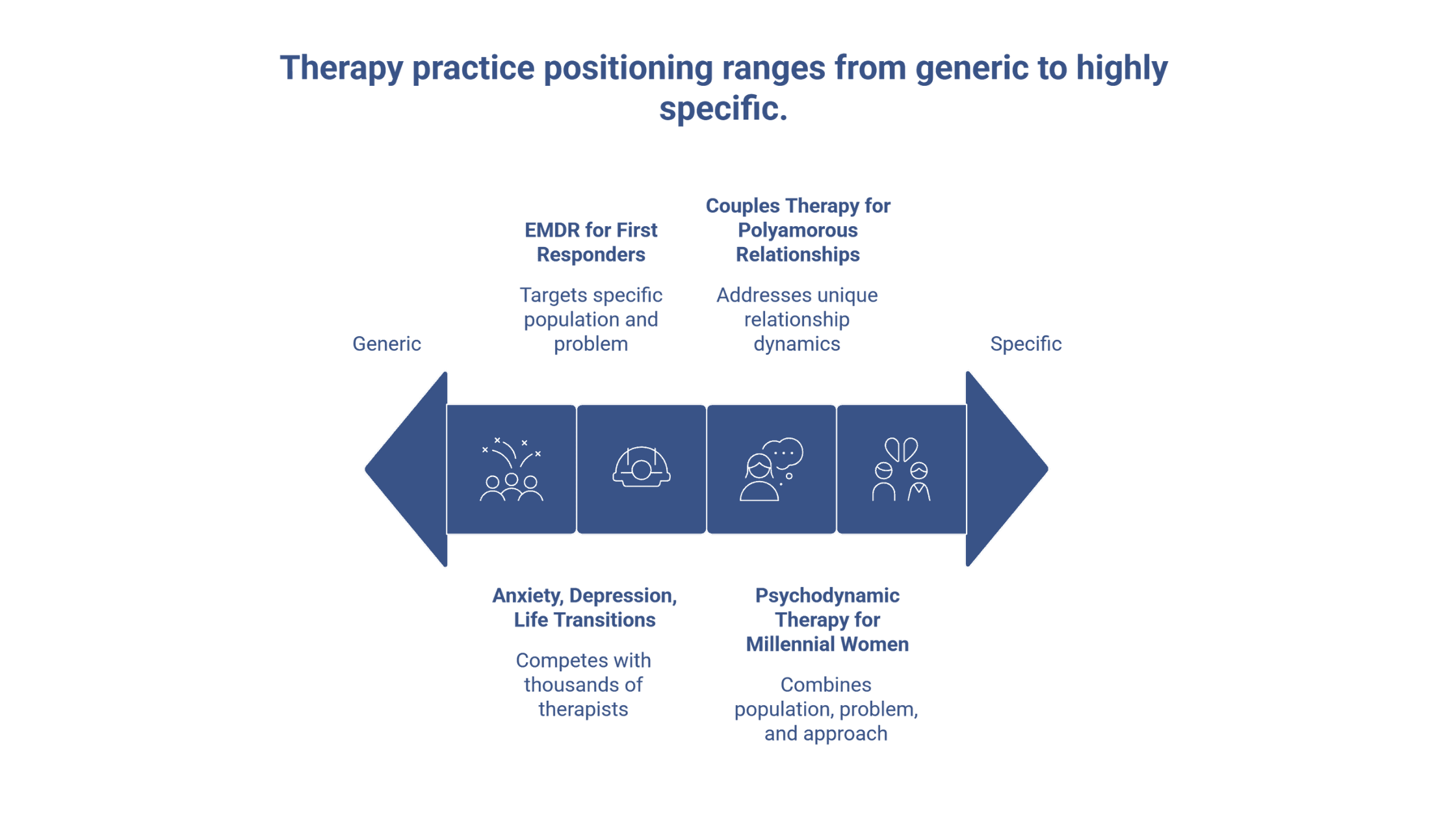
Generic positioning kills therapy practices in search results and referrals. When you say you treat "anxiety, depression, and life transitions in adults," you're competing with thousands of other therapists using identical language. Prospective clients have no idea if you're right for their specific situation.
Strong niches combine three elements: the population you serve, the specific problem or lived experience they bring, and your particular approach or modality. "EMDR for first responders with occupational trauma" is a niche. "Psychodynamic therapy for millennial women navigating quarter-life career transitions" is a niche. "Couples therapy for polyamorous relationships dealing with jealousy and communication breakdowns" is a niche. Each one immediately signals to both potential clients and referral sources exactly who you help and filters out poor fits before they waste your intake time.
A group counseling practice saw this transformation firsthand. After rebranding their website around specific niches (trauma-informed care, couples therapy, EMDR) and adding dedicated service pages for each, they tracked organic traffic up 214% and inquiries up 173% within 12 months. Their average clinician caseload moved from roughly 60–70% capacity to consistently 90–100% full, simply because clients could immediately see whether the practice served their specific needs.
Niche selection should start with genuine passion and clinical strengths. Notice which sessions energize you, which topics you naturally read about, and which client populations you consistently get strong outcomes with. Then validate market demand: check local and online saturation, identify underserved groups in your area, and talk to potential referral sources about waitlists and gaps. Back your niche with real expertise through specialty continuing education, certifications, and consultation so your marketing reflects actual competence.
Once defined, your niche drives everything: website copy speaks directly to that client's pain points in their language, directory profiles use filters and keywords that match their searches, content addresses their specific questions, and networking targets the exact physicians and organizations who encounter your ideal clients.
Develop Your Unique Value Proposition
Your value proposition isn't your credentials or modalities. It's the specific transformation you deliver for your niche and why your approach produces that result better or differently than alternatives. Instead of "Licensed psychologist specializing in evidence-based CBT for anxiety," frame it as "I help high-achieving professionals stop panic attacks from derailing their careers using structured exposure work and nervous system regulation, typically within 12–16 sessions."
The structure that works: [problem your ideal client faces] + [your role/approach] + [typical outcome or process]. Be concrete about what changes, not just that you "provide support" or "create a safe space." Prospective clients are evaluating whether therapy with you will actually solve their problem. Vague language about "healing journeys" doesn't answer that question.
Test your value proposition by sharing it with colleagues and non-therapist friends: can they immediately picture who you help and what you do? If they respond with "so, therapy?" you're still too generic. If they say "oh, my friend dealing with X would be perfect for you," your positioning is working.
Set Realistic Marketing Goals and Budget
Private practice financial models typically allocate 5–10% of revenue to marketing and intake operations during steady-state growth, with higher percentages (up to 15–20%) acceptable when you're actively scaling or launching. For a solo therapist grossing $150,000 annually, that's $7,500–$15,000 per year, or roughly $600–$1,250 per month for all marketing activities including website hosting, directory fees, paid ads, content creation, and tools.
Translate budget into acquisition targets by calculating your allowable cost per new client. Understanding industry benchmarks helps set realistic expectations. For private-pay therapists, average client lifetime value typically ranges from $1,000–$3,000 for 8–20 sessions at $120–$180 each, while high-retention ongoing therapy can reach $3,000–$9,000+. If you're willing to spend 10–20% of LTV on acquisition, your target cost per new ongoing client is $180–$360 for typical practices.
Set specific, measurable goals tied to growth stage: a new practice might target 8–12 new client starts per month to build a full caseload within 6–9 months, while an established practice maintaining 85% utilization might aim for 3–5 new starts per month to replace natural attrition. Track volume by source (SEO, directories, referrals, ads) so you know which channels deliver at acceptable cost and quality, then reallocate budget quarterly toward what's working.
Build Your Essential Online Presence
Create a Professional, Conversion-Optimized Website
Most therapy websites fail at their core job: turning anxious visitors into booked consultations. The fix isn't fancy design—it's clarity about who you help, how you help them, and exactly what to do next, delivered in plain language that reduces rather than amplifies the stress of reaching out for help.
Start with a simple structure: homepage that immediately identifies your niche and value proposition, 2–3 focused service pages for your core offerings, an about page that humanizes you without oversharing, clear fees and insurance information, and an effortless contact/booking path. Each service page should follow the pattern: speak to the specific pain point, explain your approach and what sessions look like, address common objections (cost, time commitment, "is my problem bad enough"), and provide one clear call-to-action.
Industry data shows well-optimized healthcare sites convert 2–5% of visitors into inquiries. If your conversion rate falls below 2%, your site needs work before you drive more traffic to it.
Technical requirements matter: your site must load in under 3 seconds on mobile, display perfectly on phones, use legible typography with sufficient white space, and avoid clinical jargon. Include visible trust signals (your full credentials and license numbers, professional photos, insurance panels accepted, and brief testimonials if your licensing board allows them) to reduce uncertainty about your legitimacy and competence.
Never bury your phone number or hide your contact form behind multiple clicks. Visitors in crisis or finally ready to ask for help won't hunt through your site. They'll leave and call the next therapist whose number is visible. Use a HIPAA-compliant contact form that collects only name, contact info, and a brief optional note about their needs, and respond within 4 business hours to every inquiry with a warm, specific message, not a generic auto-reply.
Claim and Optimize Your Google Business Profile
Your Google Business Profile is the highest-impact free marketing tool available to therapists, but most profiles sit barely completed and outdated. A Denver couples therapist who systematically optimized their GBP (adding weekly posts, requesting reviews from satisfied clients, and uploading current photos) went from 8 to 34 reviews over six months. Their map pack inquiries increased from 2 to 9 per month, generating 5 new ongoing clients monthly at essentially zero cost.
Set yours up as a service-area business if you're primarily telehealth or go to clients, which lets you hide your street address and define the cities or ZIP codes you serve. Choose one highly specific primary category from Google's taxonomy (e.g., "Psychotherapist," "Marriage or relationship counselor," "Family counselor") rather than generic "Mental health service," then add your actual specialties as services using real-world keywords people search for: "EMDR therapy," "couples counseling," "anxiety treatment," "trauma therapy," "telehealth sessions."
Complete business hours including holiday hours, add appointment booking links, connect your website, and write a detailed business description that naturally includes your city, neighborhoods served, and key specialties. Upload current, high-quality photos every month: professional headshots, your office space, exterior/building entrance if clients come in-person, and any certifications or licenses visible in your space. Use Google Posts to share monthly updates about openings, workshops, or quick mental health tips. These keep your profile active and can appear in search results.
The single most important ongoing activity is systematically generating and responding to Google reviews. Build this into your client offboarding: at the end of successful work together, send a brief email thanking them for their progress and including a direct link to review your profile, emphasizing that sharing their experience (without clinical details) helps others find the right support. Respond to every review—positive or negative—with professional, generic language that never confirms someone is your client.
List Your Practice in Therapy Directories
The three essential directories for client acquisition are Psychology Today (highest traffic and volume for most therapists, but expensive and competitive), Zocdoc (best for insurance-based practices and clients who want instant online booking with in-network filters), and GoodTherapy (moderate traffic, strong reputation, good for establishing credibility). Add TherapyDen if you serve LGBTQIA+, polyamorous, kink-affirming, or other progressive/marginalized communities, as its 140+ filters help niche-focused clients find exactly the right fit.
Treat directory profiles like mini landing pages with the same conversion optimization principles: lead with your specific niche and who you're best for, use the client's language to describe their struggles, explain your approach in plain terms, list your actual availability and response time, and make it effortless to contact you. Upload a professional but warm photo where you look like someone approachable in a moment of vulnerability.
Psychology Today ROI varies dramatically by market saturation. Practices in competitive metros (NYC, LA, SF) report 2–6 qualified inquiries monthly from premium profiles, while smaller markets might see 8–12. Track your cost per client—anything under $50 is excellent, $50–$150 is solid, above $200 suggests poor profile optimization or market saturation. If you're not getting at least 2–3 qualified inquiries per month after 90 days, consider reallocating that budget to Google Ads or content marketing.
Attract Clients Through Search Engine Optimization (SEO)
Local SEO Strategies for Therapists
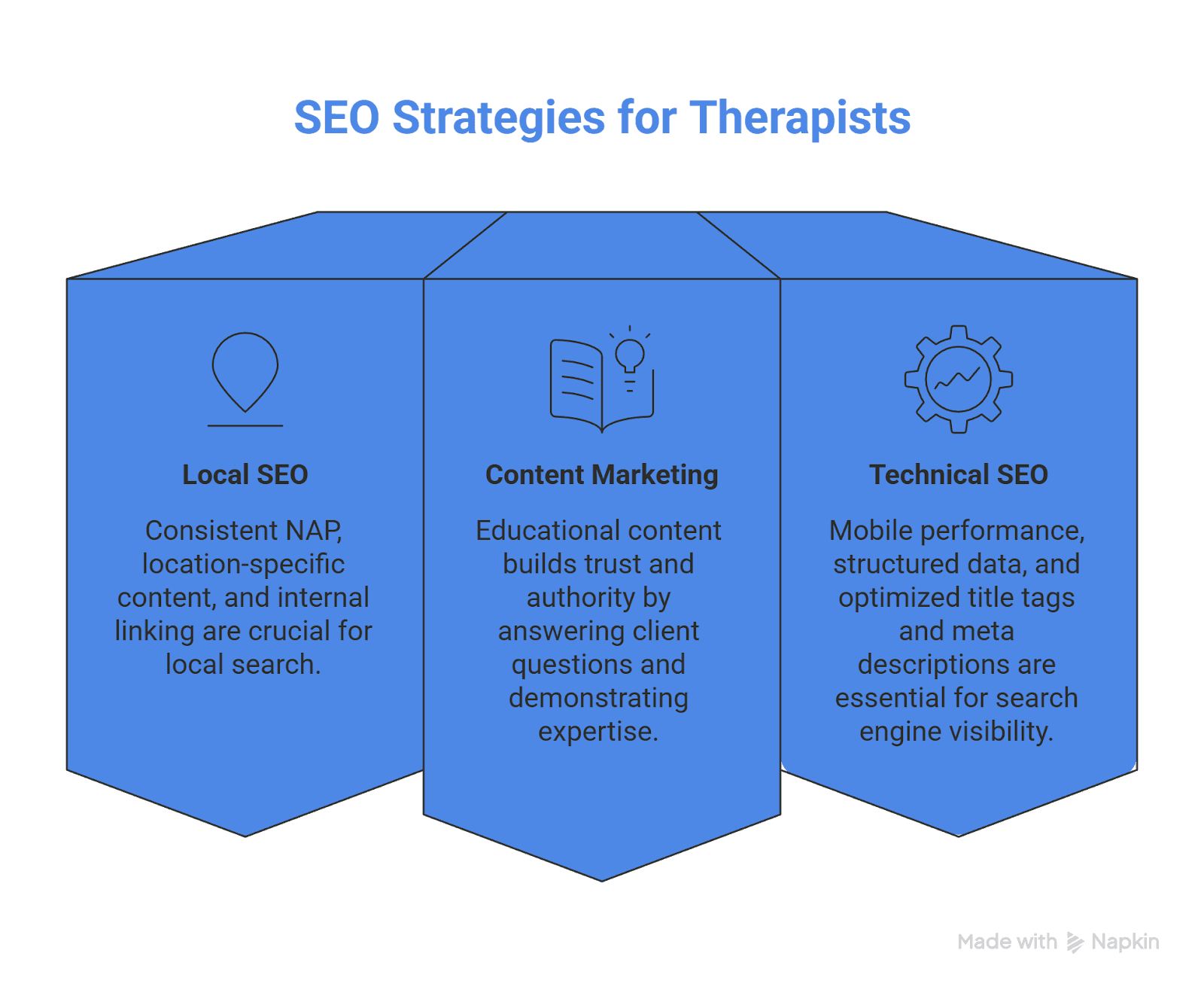
Local search drives the majority of new client inquiries for most therapy practices. The foundation is consistent NAP (name, address, phone number) across every platform: your website, Google Business Profile, Psychology Today, insurance directories, Healthgrades, your email signature, and social profiles. Even small inconsistencies dilute your local authority and confuse search engines about which entity is the real you.
Build location-specific content that demonstrates deep local presence: write blog posts addressing mental health issues through a local lens ("Managing seasonal affective disorder during Denver's winter months," "Postpartum support resources for new parents in Austin"), create neighborhood service pages if you serve multiple areas within a metro, and mention local landmarks, transit options, and parking in your contact and about pages.
Internal linking matters more than most therapists realize: link from your blog posts to relevant service pages, connect your about page to your specialties, and create content clusters around your core niches. Search engines use these connections to understand your site's structure and topical authority, boosting rankings for your target keywords.
Content Marketing That Builds Trust and Authority
Educational content solves the fundamental challenge of therapy marketing: potential clients need to trust you with their mental health before they'll reach out, but they can't experience your clinical skills until they're already in session. Blog posts, videos, and resources let them evaluate your expertise, approach, and whether you "get" their specific situation before ever scheduling a consultation.
Focus content on the questions your ideal clients actually ask in initial consultations: "How do I know if I need therapy or if I'm just being dramatic?" "What happens in the first session?" "How long does trauma therapy take?" "What if I've tried therapy before and it didn't work?" "How do I afford therapy without insurance?" Write answers in the same warm, direct, jargon-free language you'd use in person. Each piece should naturally lead to a soft call-to-action that invites them to book a consultation if the content resonates.
Aim for one substantive piece per month rather than weekly surface-level posts. Search engines and readers both reward depth and usefulness over frequency. A 1,500-word guide to "What to expect in your first trauma therapy session" with specific examples of how you structure intake, common feelings that come up, and how you help clients feel safe is worth more than ten 300-word generic posts. Repurpose each piece: turn a blog post into an email newsletter, quote key sections on social media, record a video version, or offer it as a PDF download to build your email list.
Technical SEO Basics for Therapy Websites
Technical SEO is the infrastructure that determines whether search engines can find, understand, and rank your content. Start with mobile performance: 79% of healthcare providers planned to use their website and SEO as their top lead generation tactic in 2024, but most therapy site visitors are on phones late at night or during lunch breaks. Your site must load fully in under 3 seconds on mobile, display readable text without zooming, and offer tap-friendly buttons and forms.
Implement basic structured data (schema markup) to help Google understand your site's content. At minimum, add LocalBusiness schema with your location and services, Physician or MedicalBusiness schema for your practice type, and FAQPage schema for any Q&A content. Tools like Schema Pro or Yoast SEO make this relatively straightforward, and the payoff is eligibility for rich results (star ratings, location maps, FAQ answers) that increase click-through rates.
Every page needs a unique, descriptive title tag (50–60 characters) and meta description (150–160 characters) that includes relevant keywords naturally. For a trauma therapist in Portland, "EMDR Trauma Therapy Portland | [Your Name], Licensed Psychologist" beats generic "Home | Dr. Smith Psychotherapy."
Leverage Social Media to Connect With Potential Clients
Choose the Right Platforms for Your Audience
In 2025, 29% of U.S. adults say they have learned about mental health from social media, and 34% of teens say they at least sometimes get mental health information there, making social platforms a genuine discovery channel for therapists who serve those demographics. But trying to maintain active, quality presence on every platform burns you out without strategic payoff.
For therapists serving adults, YouTube and Facebook offer the broadest reach and longest content lifespan. Instagram works well for younger adults and visual storytelling formats (short mental health tips, Q&A in Stories, "myth vs fact" carousel posts). LinkedIn is underutilized but effective if you serve professionals, work with corporate EAP programs, or want physician and referral-source visibility. TikTok requires consistent short-form video output but reaches Gen Z and young millennials.
Choose one or two platforms where your ideal clients actually spend time. Post consistently but modestly (3–4 times per week on Instagram, 2–3 videos per month on YouTube, daily or every-other-day on TikTok if you use it) rather than burning out on daily multi-platform presence that compromises your clinical work.
Create Valuable, Ethical Content That Resonates
The most effective therapist content follows a pattern: identify a specific misconception or question your ideal client has, explain the accurate information in plain language, give them something immediately actionable (a coping skill, reframe, or self-assessment question), and close with a gentle invitation to reach out if they're struggling with this issue.
Examples that work: "3 signs your anxiety is actually trauma" (explaining physiological differences with grounding exercise), "What therapists actually notice in your first session" (demystifying intake to reduce fear), "Why your coping skills stop working under high stress" (nervous system education with practical reset technique), or "How to know if you're ready to stop therapy" (normalizing endings and supporting autonomy). Keep each piece tightly focused on one insight.
Never provide individualized advice or assessment in comments, DMs, or responses. Redirect with language like "This is a pattern I see often, and it's definitely worth exploring with a therapist who specializes in [topic]." Include clear disclaimers: this content is educational only, not a therapeutic relationship, not monitored for crisis situations, and includes links to 988 and local crisis resources.
Build Engagement Without Compromising Boundaries
Social media marketing for therapists walks a difficult line: you need to be relatable and human enough that potential clients feel they could work with you, but not so personal that you blur professional boundaries. The guideline that works: share your professional perspective, values, and approach freely, while keeping specific personal details (your own therapy journey, relationships, struggles) minimal and only when directly relevant to demonstrating clinical insight.
Use engagement strategies that protect boundaries: polls and question stickers about general topics ("What therapy myth should I address next?"), Q&A formatted as "common questions I get" rather than personalized advice sessions, and encouraging discussion in comments about the ideas you share rather than individuals' personal situations. Never "friend" or follow current clients, avoid liking or commenting on their posts, and respond to private messages about services during business hours only.
When followers share their own stories in comments, respond with warmth but maintain general language: "Thank you for sharing—it takes courage to open up about this. I'm glad the post resonated. If you're looking for support with this, I'd be happy to discuss whether I could be a good fit" rather than offering clinical guidance without proper evaluation.
Implement Paid Advertising for Faster Results
Google Ads for Therapy Practices
Google Search ads are the highest-intent paid channel for therapy practices because they capture people actively searching for help right now. Healthcare advertisers see average ROAS around 3.6×, and search campaigns in the Physicians & Surgeons category show CTR around 6.73% with conversion rates around 11.62%—significantly above general advertising benchmarks.
A telehealth-only California practice started with $400 monthly on Google Search ads targeting "online anxiety therapy California." First month delivered 12 inquiries at $33 each, but only 2 became clients (a $200 cost per client, above their $150 target). After refining their landing page clarity and response time, month three converted 8 of 14 inquiries into clients, dropping cost per client to $70 and making the channel profitable.
Focus your budget on exact-match and phrase-match keywords that include your specialty, modality, and location: "EMDR therapist Denver," "trauma therapy near me," "online therapy for depression [city]," "[condition] counselor accepting Cigna." Avoid broad-match generic terms like "therapy" that burn budget on low-intent searches.
Expect healthcare CPC around $4.22, with subcategories up to $6.69, and cost per lead averaging $50–$150 depending on competition. With typical inquiry-to-client conversion of 30–60%, that yields roughly $150–$400 per new client via Google Ads in most therapist markets.
Your ads must comply with platform restrictions: Google and Meta prohibit targeting based on mental health conditions. Write ad copy that speaks to the problem and outcome without sensationalizing: "Struggling with panic attacks? EMDR therapy can help you feel safer in your body. Evening appointments in Denver." Link each ad to a specific, relevant landing page that continues the same message and makes scheduling effortless.
Track beyond clicks: measure cost per inquiry, cost per scheduled consultation, and cost per attended first session. If Google Ads generates inquiries at $80 each but only 30% become clients while Psychology Today costs $150 per inquiry with 65% conversion, Psychology Today delivers better ROI.
Social Media Advertising Strategies
Social media ads work best for therapy practices as a retargeting and awareness layer, not primary acquisition. Facebook and Instagram users aren't actively searching for therapy when your ad appears, so conversion rates are lower and timelines longer compared to Google Search. But cost per click is also much cheaper, making social useful for staying visible to people who visited your website but weren't ready to book yet.
Start with a small retargeting campaign (budget as low as $5–$10 per day): create a custom audience of people who visited your website in the past 30–90 days but didn't submit your contact form, and show them a simple ad reminding them you have openings. Many prospective therapy clients visit multiple therapists' websites over weeks or months while working up the courage to reach out. Retargeting keeps you top-of-mind when they're ready.
For broader prospective client targeting, use demographic and interest combinations that approximate your niche without violating platform policies: "Age 25–45 + interest in mindfulness, psychology, self-improvement + lives in [city]" might reach young professionals open to therapy. Test 3–4 different ad creative approaches and pause what doesn't generate meaningful engagement after two weeks.
Set realistic expectations: social ads typically produce inquiries at $30–$100 per lead for therapy services, but conversion to ongoing clients is often 20–40% lower than Google Search leads because intent is softer. Use social advertising to supplement high-intent channels, not replace them, and only after your website and intake process already convert well.
Setting Budgets and Measuring ROI
Allocate paid advertising budget using a 70/20/10 framework: spend 70% on channels and campaigns you know work, allocate 20% to promising tests (a new geographic area, a different specialty landing page, retargeting campaigns), and reserve 10% for true experiments. Promote winners from the 20% and 10% buckets into the 70% allocation based on actual client acquisition data, not vanity metrics like impressions or page views.
For a solo therapist just starting with paid ads, begin with $300–$500 per month split 80% to Google Search and 20% to Facebook/Instagram retargeting. Track obsessively: every inquiry source, every consultation scheduled, every first session attended, and the progression from there to ongoing client. Calculate actual cost per new ongoing client (total ad spend ÷ number of clients who attended 3+ sessions) and compare against your allowable cost based on client lifetime value.
Avoid the common trap of judging success by cost per click or click-through rate. A campaign with $12 cost per click that converts 15% of clicks into clients at $220 total cost per client wins over a campaign with $3 cost per click converting at 2% for $450 per client, even though the second "looks" more efficient in ad dashboards.
Build a Referral Network That Drives Consistent Growth
Develop Relationships With Healthcare Providers
Physician referrals remain one of the most qualified, highest-converting client sources for therapists because they carry implicit trust and clear clinical need. Primary care doctors, OB/GYNs, pediatricians, psychiatrists, and specialists frequently encounter patients whose conditions have mental health components but lack go-to therapists they trust.
Referrals from physicians and word-of-mouth typically deliver the lowest effective acquisition cost—often $0–$50 per client in out-of-pocket marketing spend, with conversion rates often 70–90%+ to ongoing clients, similar to top-performing healthcare specialty channels.
Identify 10–15 physicians whose patient populations align with your niche, then make yourself genuinely useful. Send brief, helpful emails or printed materials: "Hi Dr. [name], I specialize in postpartum anxiety and depression for new moms and wanted to share this one-page handout on screening questions and when to refer." Offer lunch-and-learn presentations at their offices on topics relevant to their practice.
Communicate outcomes when appropriate and with permission: if a joint patient makes progress, send the physician a brief, HIPAA-compliant update thanking them for the referral and noting improvement. Make referrals to them as well—physicians are more likely to refer to therapists who reciprocally connect patients back to medical care. Respond to their referrals within 24 hours and get patients scheduled within a week when possible.
Create a Client Referral System
Satisfied clients are your most credible referral source, but most won't spontaneously refer friends unless you make it easy and appropriate. At the end of successful work together, explicitly say something like "I'm so glad to see the progress you've made. If you know anyone struggling with [issue you treated] who might benefit from this approach, I always welcome referrals—just have them mention your first name when they reach out so I know to thank you."
Provide tools that make referring effortless: a simple business card they can pass along, a short description they can text or email, or a referral link from your website they can share. Never offer financial incentives or discounts for referrals, which creates ethical problems. A handwritten thank-you note when someone does refer is appropriate and appreciated.
Network Strategically Within Your Community
Beyond formal physician relationships, strategic community presence generates steady referral flow. Join professional organizations where you'll meet complementary providers: your state counseling or psychology association, local women's business groups, LGBTQIA+ professional networks if that's your niche, or business associations if you work with professionals and executives.
Offer free or low-cost workshops to organizations that serve your ideal clients: parenting groups, employee wellness programs, university counseling center outreach, domestic violence shelters, substance abuse programs, PFLAG chapters, retirement communities. Position these as pure psychoeducation rather than pitches, but ensure attendees know how to find you if they want individual work.
Create a simple networking habit: coffee or lunch with one potential referral source per month. Another therapist with a complementary specialty, an HR director, a school counselor, a yoga studio owner whose clients struggle with trauma, a divorce attorney whose clients need support. Bring curiosity about their work and look for ways to be genuinely helpful. Reciprocal, mutually beneficial relationships generate more and better referrals than transactional networking.
Use Email Marketing to Nurture Client Relationships
Email is the only marketing channel therapists fully control. Social platforms change algorithms, Google adjusts ranking factors, but your email list is yours. Use it to stay connected with people who've expressed interest but aren't ready to start yet, maintain relationships with past clients (ethically and with permission), and position yourself as a trusted resource for professional referral sources.
Build your list through lead magnets that solve a genuine problem: a downloadable PDF workbook ("5-Day Anxiety Reset: Daily practices to calm your nervous system"), a recorded workshop ("How to know if you need therapy"), a printable resource list ("Mental health crisis resources in [city]"), or a short email course ("Understanding your first therapy session"). Gate these behind a simple email opt-in form using a HIPAA-compliant email service with a signed Business Associate Agreement like Mailchimp (with BAA), Constant Contact (healthcare plan), or specialized platforms like SimplePractice or TherapyNotes.
Send a monthly newsletter focused on psychoeducation, not promotion: a brief article or tip related to your niche, an answer to a common question, a myth-busting post about therapy, or a seasonal mental health topic. Keep emails short—300–500 words of useful content—and include a single, non-pushy call-to-action: "If you're struggling with [issue from email], I have a few openings this month. Schedule a free 15-minute consult here: [link]."
Segment your list by relationship type when possible: potential clients who downloaded a resource get nurturing educational emails and gentle invitations to book; professional contacts like physicians get practice updates (new specialty offerings, availability changes, brief case consultation tips); past clients (only with explicit permission, carefully considering ethical boundaries) might receive a quarterly check-in. Set up a 5–7 email welcome sequence for new subscribers that introduces who you help and your approach, then transitions them to your monthly general newsletter.
Encourage and Manage Online Reviews and Testimonials
73.3% of patients consider online reviews when choosing a healthcare provider, and among those, 70% require a minimum 4-star rating. Reviews function as modern word-of-mouth. They're often the tiebreaker between you and another therapist with similar credentials and availability. But therapy reviews require careful ethical navigation because asking current clients creates power dynamics and publishing identifiable testimonials without proper authorization violates HIPAA and professional ethics.
Build a review system around former clients who've successfully completed work with you, not current clients in ongoing treatment. At your final session or in a follow-up email 1–2 weeks after ending, send a brief, warm message: "It's been an honor to work with you on [general issue, not specifics], and I'm grateful to have witnessed your growth. If you're comfortable sharing your experience to help others considering therapy, I'd appreciate a review on Google or [directory platform]. Here's the direct link: [URL]. I understand this is optional, and it won't affect our professional relationship in any way."
Respond to every review professionally without confirming the reviewer is or was your client. For positive reviews: "Thank you for sharing your experience. I'm grateful to support individuals working toward [general issue mentioned in review], and I wish you continued growth." For negative reviews: "I appreciate you taking time to share feedback. Protecting confidentiality prevents me from discussing specific situations publicly, but I'd welcome the opportunity to address your concerns directly. Please contact my office at [number]." Never defend yourself or imply you remember the reviewer—any of those responses can inadvertently confirm a therapeutic relationship and constitute a HIPAA violation.
Public testimonials require explicit, written HIPAA authorization that specifies exactly what information will be shared, where it will appear, and confirms the client's voluntary participation. Even with authorization, minimize identifiable details: use first name only or initials, age range rather than exact age, and general descriptors rather than unique identifying information. Many therapy practices find that strong Google and directory reviews matter more than website testimonials anyway, since potential clients trust independent platforms more.
Marketing Ethics and Compliance for Therapists
HIPAA Considerations in Digital Marketing
HIPAA creates a fundamental tension in therapy marketing: effective digital marketing usually requires tracking visitor behavior, collecting contact information, and segmenting audiences. These activities become protected health information disclosures when they involve therapy clients or reveal someone is seeking mental health treatment. The core rule: if a tracking tool, form, or marketing platform can create, receive, maintain, or transmit information that identifies someone and relates to their health or healthcare, it's handling PHI and requires HIPAA compliance.
This breaks many standard marketing tools. HHS Office for Civil Rights explicitly states that transmitting PHI to tracking technology vendors for marketing without authorization is a HIPAA violation, explicitly naming analytics, advertising, scheduling, and social media integrations as high-risk. HHS and FTC have sent joint warning letters to roughly 130 hospital and telehealth providers over impermissible disclosures via pixels and other trackers, and FTC's $1.5M action against GoodRx for sharing health-related data with Facebook and Google is a digital-marketing HIPAA benchmark.
Problematic tools and practices include:
Meta (Facebook) Pixel on appointment/scheduling pages, patient portal login, or condition-specific pages, which can send IP address, device IDs, page paths, and button clicks to Meta—treated as PHI when tied to health-related content.
Google Analytics 4 on sensitive health pages, collecting event-based data that can infer medical intent or treatment seeking.
Programmatic ad networks and retargeting platforms that build audiences based on site visits to mental health pages, effectively disclosing PHI to ad platforms.
Session replay tools (Hotjar, FullStory) that can record keystrokes and form fills, capturing appointment details or symptoms as PHI.
The fix: use HIPAA-compliant analytics platforms like Piwik PRO, self-hosted Matomo, or privacy layers like Freshpaint that prevent PHI from reaching non-compliant downstream tools, all backed by signed Business Associate Agreements.
Email marketing and forms require similar care. Any email list that includes people who've submitted your contact form (which often asks about presenting issues), current or former clients, or anyone whose presence reveals they're seeking mental health services involves PHI. For website forms, HIPAA-aligned guidance specifies they must use encrypted forms, include a link to your HIPAA Notice of Privacy Practices, store submitted data securely, obtain patient consent where applicable, and avoid non-compliant tracking technologies on or around forms.
Use email platforms that offer HIPAA plans with BAAs and encryption (Mailchimp HIPAA, SimplePractice or TherapyNotes built-in email, or specialized healthcare platforms) and never upload client email lists to regular marketing tools without proper safeguards.
Social media is generally not HIPAA-compliant for clinical communication or PHI collection. Never discuss someone's treatment, confirm they're your client, or collect intake information via direct messages, comments, or public posts. Include disclaimers on all social profiles: this is educational content, not a therapeutic relationship, not monitored for emergencies, and includes crisis resource links.
Ethical Boundaries in Social Media and Content
Professional ethics codes converge on core social media principles: maintain boundaries, protect confidentiality, avoid exploitation or coercion, and clearly separate psychoeducation from therapy. Applied to marketing, this means never soliciting testimonials from current clients, not "friending" or following clients' personal accounts, avoiding dual relationships that blur professional roles, and not providing individualized clinical advice or assessment in public forums.
Content must distinguish clearly between general mental health education (appropriate for blogs, videos, social media) and therapeutic intervention (requires a formal therapeutic relationship with proper informed consent and confidentiality protections). Every piece of public content should include clear disclaimers: "This information is for educational purposes only, is not a substitute for professional mental health services, and does not constitute a therapeutic relationship. If you're in crisis, contact 988 or your local emergency services."
When discussing clinical examples, use fully de-identified composites that cannot be traced to real clients even by those clients themselves, and never share without explicit written authorization if any identifiable details remain.
Your social media policy should be documented and shared with clients as part of informed consent: clarify that you do not provide therapy via social media, will not respond to clinical questions in DMs or comments, will not accept friend/follow requests from clients, and that any online interactions you observe will not be discussed in therapy sessions unless the client brings it up. Review and follow your professional association's guidance (APA's Social Media Guidelines, NASW's Technology Standards, or ACA's social media ethics resources).
State Licensing Board Requirements
Advertising rules vary by state and profession (psychologists, LPCs, LMFTs, LCSWs face different specific regulations), but common requirements include: no false, misleading, or deceptive advertising; accurate representation of credentials, titles, and licensure status (with license numbers often required); prohibitions on claiming specialization or board certification not recognized by your board; and restrictions on testimonials, comparative claims, or guarantees of results. Some states require specific disclaimers about licensure status, supervision relationships for associates, or telehealth limitations.
Multistate telehealth practices add complexity: if you advertise availability in another state, most boards expect you to already hold a license or privilege to practice in that state before advertising services there. The Psychology Interjurisdictional Compact (PSYPACT) and Counseling Compact simplify this for eligible professionals, but even compact privileges don't override individual state advertising laws—you must still review and comply with each member state's advertising rules.
Check your specific licensing board's website for current advertising regulations, and when in doubt, consult with an attorney familiar with healthcare and professional licensing law in your state. Most boards provide example-compliant advertising language or FAQs. Use those as templates rather than copying language from out-of-state therapists whose requirements may differ.
Measure, Analyze, and Optimize Your Marketing Efforts
Marketing without measurement is expensive hope. The metrics that matter for therapy practices are: cost per new client (total marketing spend ÷ new clients who attend 3+ sessions), lead-to-client conversion rate (percentage of inquiries that become ongoing clients), website conversion rate (percentage of visitors who submit contact form or call), client lifetime value (average revenue per client over full episode of care), and new client volume by source.
Understanding industry benchmarks helps evaluate your performance. For therapy practices, realistic expectations include:
Website visitor-to-inquiry conversion: 2–5% of visitors submitting an inquiry is solid for well-optimized sites.
Inquiry-to-first-session conversion: Average 30–60% of inquiries become an attended first session, with high-performing practices reaching 60–80% when response times are fast and intake is streamlined. Psychiatry shows ~75.6% prospect-to-patient conversion, among the highest in medical specialties.
Overall lead-to-patient conversion: Across healthcare organizations, average conversion rate is 10–15%, though well-run psychotherapy practices with quick response times often achieve 25–50%.
Track every inquiry source religiously. Use unique phone numbers for each major marketing channel (Google Voice numbers are free), UTM parameters on all links you share, and ask every new client in intake: "How did you find me?" Maintain a simple spreadsheet or use your practice management system to log: date, source, inquiry method, whether they scheduled consultation, whether they attended first session, and whether they became ongoing clients.
Calculate your actual return on marketing investment by channel. If you spent $200 on Google Ads and $120 on directory fees in a month, acquired 8 new clients total (5 from Google, 3 from directories), and your average client lifetime value is $1,650, your returns look like: Google Ads cost $40 per client, generated $8,250 in client value, 41× return; directories cost $40 per client, generated $4,950 in value, 41× return. But if next month directories jump to $50 per client while Google drops to $30, shift more budget to Google.
Set up quarterly reviews of your full marketing system: website performance (conversion rates, page speed, mobile usability), SEO rankings for your target keywords, directory profile views and clicks, social media engagement and website referrals, ad campaign cost per client, referral source diversity and volume, and email list growth and engagement. Look for trends and breakdowns: a sudden conversion rate drop might signal a website issue, declining organic traffic could mean SEO erosion, increasing cost per client from ads suggests saturation or creative fatigue. Treat marketing as a living system that requires ongoing optimization.
Common Marketing Mistakes Therapists Should Avoid
The biggest marketing mistake therapists make is treating it as something you do only when your caseload dips, creating boom-and-bust cycles that produce stress and poor client fit. Marketing is a system that runs continuously at lower intensity when you're full (keeping profiles updated, publishing occasional content, maintaining referral relationships) and scales up when you have availability, not something you turn entirely on and off.
A common failure pattern illustrates this: one practice spent 8 months building Instagram to 2,000 followers but generated only 3 client inquiries because their website still buried contact information and used clinical jargon. After redesigning their site for conversion clarity, those same 2,000 followers generated 12 inquiries in the next 6 weeks. This highlights the second major mistake: chasing traffic while ignoring conversion optimization is like trying to fill a bathtub with the drain open.
Another expensive mistake: running broad-match Google Ads for "therapy" and "counseling" without geographic or specialty restrictions. One practice burned $1,200 in 3 weeks on clicks from people searching "marriage counseling" (they only see individuals), "physical therapy" (wrong field), and cities where they're not licensed. Switching to exact-match, specialty-focused keywords cut their cost per relevant inquiry from $95 to $22.
Generic, credential-focused positioning kills your visibility and appeal. Saying you're "a licensed therapist specializing in anxiety, depression, and life transitions" makes you identical to thousands of other profiles. Prospective clients can't tell if you're right for their specific situation, referral sources don't know when to send people to you, and search engines can't rank you well because you're trying to be everything to everyone. Niche specificity (who you help, with what specific problems, using what approach) is the foundation every other marketing effort builds on.
Overlooking HIPAA and ethics compliance in digital tools creates legal and professional risk that's not worth the marginal marketing benefit. Using regular Google Analytics without proper configuration, collecting intake details through insecure contact forms, posting client testimonials without written authorization, or providing individualized clinical advice in social media comments might feel like "everyone does it," but professional discipline and federal enforcement are both increasing focus on healthcare privacy in digital marketing. The cost of HIPAA-compliant tools and ethical content strategies is far lower than defending a board complaint or OCR investigation.
Creating Your Therapy Marketing Action Plan
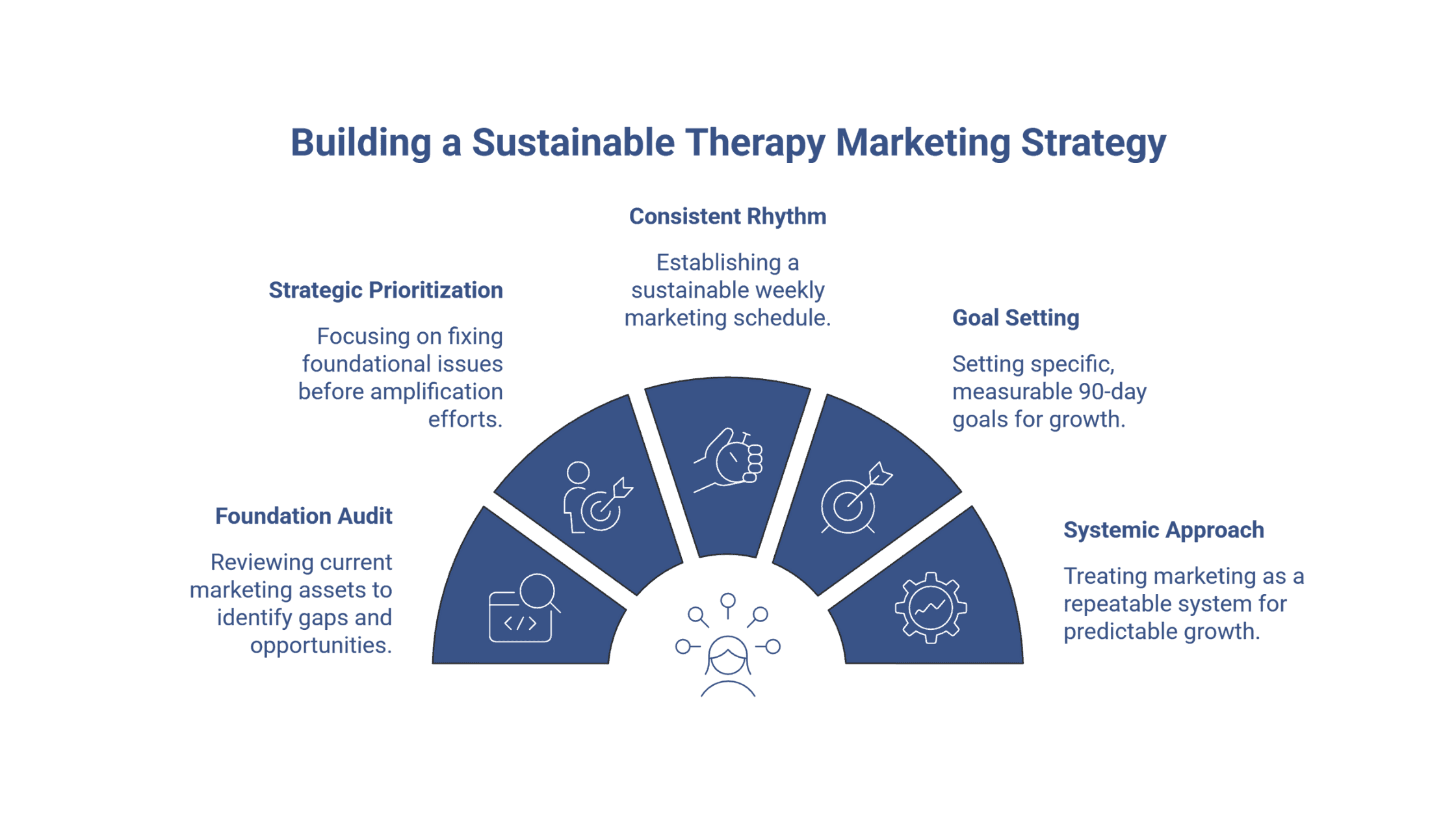
Start by auditing what you have: review your current website (clarity, mobile performance, contact process), Google Business Profile (completion, photo freshness, review volume), directory listings (accuracy, positioning), social media presence (consistency, engagement), and referral relationships (who's actually sending clients, who you've neglected). Identify the 3–5 highest-impact gaps. Often these are: unclear niche positioning across all channels, incomplete or unoptimized Google Business Profile, poor website conversion design, no systematic review generation, or lack of any tracking to know which sources work.
Prioritize foundation over amplification. If your positioning is generic or your website doesn't convert, do not spend money on ads or waste time creating social media content. Fix the foundation first. The right sequence for most therapy practices: 1) Define clear niche and value proposition, 2) Update website, Google Business Profile, and directory profiles with new positioning, 3) Build basic tracking and inquiry response system, 4) Start one systematic outreach effort (monthly blog content, physician relationship building, or social media), then 5) Add paid advertising only when conversion rates prove the funnel works.
Create a realistic monthly rhythm you can sustain alongside clinical work: dedicate 2–3 hours per week to marketing activities rather than binge-working it sporadically. Example weekly cadence: 30 minutes responding to new directory messages and inquiries, 30 minutes generating and responding to Google reviews, 60 minutes creating or scheduling content (one blog post monthly = 15 minutes per week, broken down), 30 minutes checking analytics and adjusting what's not working. Schedule it like client sessions so it actually happens, and consider this clinical session equivalency: those 2–3 marketing hours per week likely generate 1–2 new clients per month, representing $2,000–$6,000 in annual revenue per hour invested.
Set specific, measurable 90-day goals tied to the metrics that matter. Examples: increase new client inquiries from 8 to 12 per month, improve inquiry-to-first-session conversion from 55% to 65%, grow Google review count from 12 to 25, generate 3 new physician referral sources, reduce cost per client from Google Ads below $300, launch monthly email newsletter to 150+ subscribers. Review progress monthly, celebrate wins, and adjust tactics when something clearly isn't working within 60 days.
The goal isn't to become a marketing expert. It's to build a simple, ethical, repeatable system that consistently fills your caseload with ideal clients you're genuinely excited to serve, at a cost that's sustainable for your practice economics. At William & Friends, we see this pattern across all service-based businesses: operators who treat marketing as a system rather than a periodic project grow predictably, avoid feast-or-famine cash flow, and actually enjoy their businesses more because they're working with better-fit clients and spending less time stressed about where the next referral comes from.
5 Marketing Fixes That Fill Therapy Caseloads Faster
Stop marketing "anxiety and depression for adults"—niche down to who you specifically help and what transformation you deliver, so ideal clients immediately recognize themselves in your messaging instead of scrolling past another generic therapist profile.
Optimize your Google Business Profile weekly, not once—upload fresh photos monthly, post updates about openings or topics, and systematically request reviews from satisfied former clients using a simple post-therapy email with a direct review link to dominate local map results.
Fix your website conversion before spending a dollar on ads—if fewer than 3% of visitors contact you, your problem isn't traffic volume, it's that your site doesn't make anxious potential clients feel safe reaching out or doesn't clearly explain who you help and why they should choose you.
Track cost per actual client, not cost per click or inquiry—a channel that generates cheap inquiries with low conversion to ongoing clients loses to more expensive leads that consistently book and stay, so measure what matters: revenue per marketing dollar spent.
Build one systematic outreach habit instead of random marketing bursts—monthly physician lunch-and-learns, weekly educational social posts, or bi-weekly blog content done consistently generates far more growth than sporadic "I need clients NOW" scrambles when your schedule has openings.
Frequently Asked Questions About Marketing for Therapists
How much should a therapist spend on marketing?
Most established therapy practices allocate 5–10% of gross revenue to marketing and intake operations during steady-state growth, with higher percentages (up to 15–20%) acceptable when actively scaling or launching. For a solo therapist grossing $150,000 annually, that's $7,500–$15,000 per year for all marketing: website, directories, ads, content, and tools. New practices should expect to invest more heavily in the first 1–2 years to build initial visibility and caseload, then reduce to maintenance levels once full. Calculate your acceptable cost per new client based on average client lifetime value. If clients generate $1,500–$2,000 on average and you're willing to spend 10–20% on acquisition, you can afford $150–$400 per new ongoing client, which guides monthly budget allocation across channels.
Do therapists need to be on social media to attract clients?
Social media helps but isn't required. Many successful therapy practices fill entirely through Google search, directories, and professional referrals without active social presence. The question is whether your ideal clients use social platforms to learn about mental health and evaluate providers. 29% of U.S. adults learn about mental health from social media, and the percentage is far higher for younger demographics, making platforms like Instagram and TikTok valuable for therapists serving millennials, Gen Z, or teens. If you do use social media, commit to one platform done consistently and ethically (educational content, clear boundaries, no clinical advice in comments) rather than spreading thin across multiple channels. Alternatively, invest that time in SEO, content marketing, or referral relationship building, which often deliver better ROI for therapists uncomfortable with social media or serving older demographics.
How can therapists get clients without violating HIPAA?
HIPAA governs how you handle protected health information in marketing, not whether you can market. The keys are: never disclose that someone is your client or seeking services without explicit written authorization, use HIPAA-compliant tools (analytics, email, forms) with Business Associate Agreements for any system that touches PHI, avoid targeting ads based on health conditions (which platforms prohibit anyway), collect minimal information on contact forms, and respond to reviews without confirming therapeutic relationships. You can freely advertise your services, share educational content, describe who you help and how, and collect general inquiries. Just keep clinical details and identifiable client information completely separate from your public marketing. When in doubt, consult with a healthcare privacy attorney or HIPAA compliance specialist to review your specific tools and practices.
What's the fastest way for a therapist to get more clients?
The fastest client acquisition comes from optimizing conversion on traffic you already have, not generating new traffic from scratch. Audit your inquiry-to-client conversion: if you're getting 10 inquiries per month but only converting 4 into clients, fixing your intake response time, initial call warmth, scheduling friction, and service clarity can quickly double your new client starts without any additional marketing spend. Next fastest is claiming and fully optimizing your Google Business Profile with great photos, accurate services, and review generation. Local map pack visibility often improves within 2–4 weeks. For paid acceleration, Google Search ads targeting "[specialty] therapist [city]" and similar high-intent keywords can generate qualified inquiries within days, but only after your website and intake funnel are ready to convert them. Avoid "get clients fast" tactics like buying leads or spamming directories. They deliver low-quality inquiries that waste your time.
Should therapists pay for Psychology Today or other directories?
Directory investment depends on ROI in your specific market and niche. Psychology Today is the highest-traffic general therapy directory and generates substantial inquiries for many therapists, but it's also expensive ($30–$40 per month) and highly competitive in major metros. Calculate your return: if PT delivers 3–5 solid inquiries per month and 60% convert to clients, that's 2–3 new clients at $10–$15 acquisition cost each—excellent ROI. If you get 1 inquiry every other month with poor conversion, cancel and reallocate that budget to Google Ads or content marketing. Start with a free or low-cost profile for 90 days, track inquiries and conversion rigorously, then upgrade to premium only if the numbers support it. Zocdoc delivers better ROI for insurance-based practices, TherapyDen for niche/values-aligned specialties, and GoodTherapy for reputation building. Most therapists benefit from 1–2 paid directories plus a strong free Google Business Profile.
How do therapists measure if their marketing is working?
Track the metrics that directly connect to your business goals: new client volume per month by source (how many clients each channel delivers), cost per new client (total marketing spend divided by clients acquired), inquiry-to-client conversion rate (percentage of contacts that become ongoing clients), and client lifetime value (average revenue per client). Set up simple tracking: unique phone numbers or UTM links for each major channel, a spreadsheet or CRM field that logs how every inquiry found you, and monthly reviews comparing spend to client acquisition across sources. If Google Ads costs you $300 per new client while physician referrals are free, but Google delivers 5 clients monthly vs. 1 from physicians, both are valuable but justify very different effort and budget allocation. Ignore vanity metrics (website traffic, social media followers, email open rates) unless you can demonstrate they correlate with actual client acquisition at acceptable cost and effort.
Conclusion
Marketing for therapists in 2026 comes down to systems, not tactics. The practices that grow predictably are building integrated marketing ecosystems: clear positioning drives website clarity and directory messaging, which feeds organic search visibility and referral recognition, supported by systematic review generation and physician relationship building, with paid ads accelerating results only after conversion infrastructure proves it works. That's the systems-thinking approach we use at William & Friends: no isolated campaigns, no "set it and forget it" websites, no hoping random social posts will somehow fill your caseload.
The therapy practices that scale successfully treat marketing as operations. They measure cost per client ruthlessly, fix what breaks in the conversion funnel immediately, and reallocate effort toward channels that deliver real clients at acceptable cost, not channels that "feel" like marketing. They understand that clarity beats cleverness: a tightly defined niche with plain-language website copy that speaks directly to one type of client's specific pain points will always outperform beautiful, generic branding that could describe any therapist in your city.
Your 2026 action plan should start with foundation: define who you're for and against, build or fix your website to convert anxious visitors into comfortable inquiries, dominate your Google Business Profile with optimization and reviews, establish presence in 1–2 high-ROI directories, then layer on content, referrals, and strategic paid advertising only when you have capacity and tracking in place to make those efforts accountable to revenue. This isn't sexy, but it works. It lets you spend less time worrying about where your next client comes from and more time doing the clinical work that made you become a therapist in the first place.
Ready to build a marketing system that actually fills your therapy practice? William & Friends designs full-stack revenue engines for therapy offices who are done guessing what works and ready for predictable growth. Talk to us about building clarity, structure, and performance tracking into your practice marketing.
Frequently asked questions
William Turner
Founder, William & Friends
Hey, I’m William, founder of William & Friends in Denver. We help service businesses get found, get chosen, and get booked. SEO, CRO, and ads tied to clean reporting. Recent wins include 908% year-over-year traffic for a commercial laundry brand and 39% more revenue attributed to organic search for a Denver studio. I write about conversion math, offer-to-channel fit, and operator-grade marketing. If you want the truth about where your pipeline leaks, grab the free marketing audit.
Success Studies
Growth Happens Here
See how our strategies have helped clients dominate their markets: