Commercial Cleaning Lead Generation Guide
Master commercial cleaning lead generation with proven strategies, digital marketing tactics, and sales systems that convert prospects into profitable contracts.

William Turner
Hey, I’m William, founder of William & Friends in Denver. We help service businesses get found, get chosen, and get booked. SEO, CRO, and ads tied to clean reporting. Recent wins include 908% year-over-year traffic for a commercial laundry brand and 39% more revenue attributed to organic search for a Denver studio. I write about conversion math, offer-to-channel fit, and operator-grade marketing. If you want the truth about where your pipeline leaks, grab the free marketing audit.
Dec 8, 2025
9
Commercial cleaning lead generation has shifted from volume-based prospecting to precision-targeted systems that track every dollar spent and every lead captured. The difference between cleaning companies stuck at seven figures and those scaling past multiple millions isn't how many leads they chase, it's the infrastructure they build to capture, qualify, and convert the right prospects consistently.
William & Friends has worked with service businesses across the country to build predictable lead systems that replace guesswork with data. The approach focuses on full-funnel clarity: understanding exactly where leads enter your pipeline, how they move through qualification, and which channels actually deliver paying contracts. For commercial cleaning businesses specifically, this means connecting marketing tactics to the operational realities of long sales cycles, multiple decision-makers, and contracts that require facility walkthroughs before closing.
TL;DR: Commercial Cleaning Lead Generation
Successful commercial cleaning lead generation requires building systems, not chasing tactics. Start by defining your ideal commercial client profile based on facility type, contract size, and decision-maker access. Establish lead tracking infrastructure through CRM platforms that connect marketing sources to closed contracts. Deploy a balanced channel mix combining local SEO for organic visibility, Google Ads for immediate lead flow, LinkedIn outreach for B2B relationships, and email nurture campaigns for long sales cycles. Traditional methods like direct mail and industry networking still deliver strong ROI when targeting facility managers. Focus on lead quality over volume by implementing pre-qualification frameworks before investing time in facility walkthroughs. Track cost per lead, conversion rates, and customer acquisition cost religiously to identify which channels actually generate profitable contracts. Scale lead generation through a hybrid approach combining in-house execution with professional services when your pipeline consistently converts but needs more volume.
Key Points |
|---|
|
Understanding Commercial Cleaning Lead Generation
Commercial cleaning operates in a B2B environment where contracts span months or years, purchase decisions involve multiple stakeholders, and price sensitivity creates constant competitive pressure. Lead generation in this space differs fundamentally from residential services. You're not selling one-time jobs to homeowners making emotional decisions. Instead, you're pursuing facility managers, property directors, and operations teams who evaluate vendors based on reliability, compliance documentation, and total cost of ownership.
The buyer landscape has shifted toward research-heavy evaluation processes. Decision-makers research cleaning contractors online before ever making contact, reviewing Google Business Profiles, reading case studies, and checking LinkedIn credentials. This front-loaded research phase means businesses lose opportunities before knowing prospects existed if visibility and credibility aren't established across multiple digital touchpoints.
What Qualifies as a High-Quality Commercial Cleaning Lead
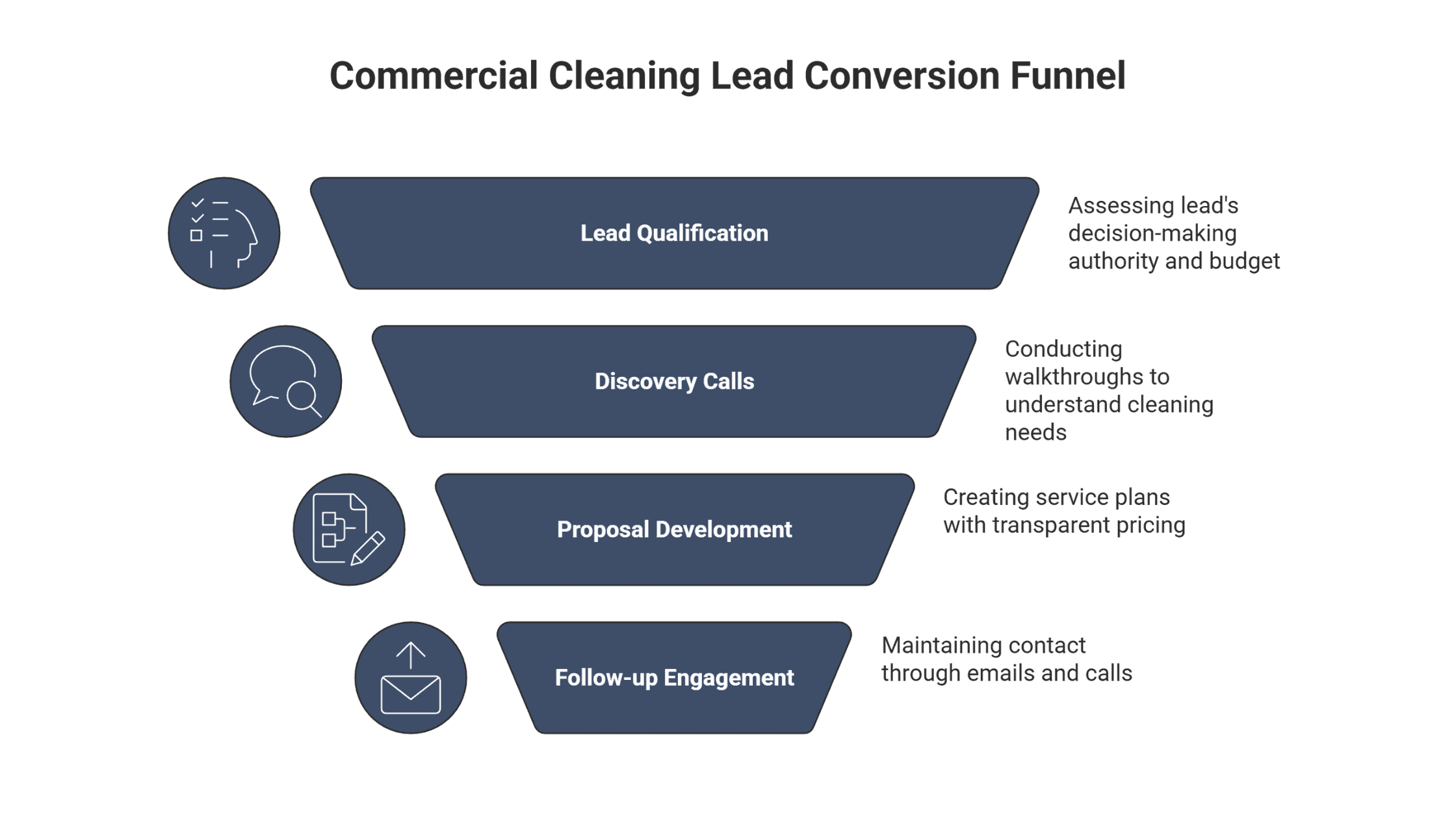
A high-quality commercial cleaning lead possesses three core characteristics: decision-making authority, budget availability, and alignment with your service capabilities. Authority means connecting directly with facility managers or property directors who can approve vendor changes without requiring multiple layers of approval. Budget availability indicates the prospect has allocated funds for cleaning services and isn't merely price shopping without commitment. Service alignment ensures the facility type, square footage, and cleaning requirements match your operational capacity and expertise.
The difference between qualified leads and time-wasters shows up in conversion economics. Quality leads move through your sales process with clear communication, scheduled facility walkthroughs, and documented requirements. Poor leads ghost after initial contact, negotiate unrealistic pricing, or disappear when requesting insurance documentation. Tracking which lead sources deliver actual signed contracts versus which generate inquiries that never convert reveals where to focus acquisition spending.
The Commercial Cleaning Sales Cycle: What to Expect
Commercial cleaning sales cycles typically span 30-90 days from initial contact to signed contracts, with variation based on facility size and organizational complexity. Large facilities with formal procurement processes extend cycles beyond 90 days as proposals move through approval chains. Small-to-medium businesses often decide faster when facility managers hold direct purchasing authority.
The cycle includes distinct stages requiring different engagement strategies. Initial contact establishes basic qualifications (facility details, current provider, contract timeline). Discovery calls or facility walkthroughs assess cleaning requirements, identify pain points with current providers, and demonstrate your expertise through detailed observations. Proposal development translates facility needs into specific service plans with transparent pricing and scope definitions.
Multiple touchpoints throughout this cycle keep your company top-of-mind without overwhelming prospects. Email check-ins provide value through facility management tips or industry updates. Follow-up calls address questions arising during internal evaluation. This sustained engagement differentiates professional operators from companies that submit proposals and disappear.
Building Your Lead Generation Foundation
Lead generation systems fail when businesses skip foundational infrastructure and jump directly to tactics. Running Google Ads without CRM tracking wastes budget on leads that fall through cracks. Launching LinkedIn outreach without ideal client profiles scatters effort across unqualified prospects.
The foundation includes three essential components: ideal client definition, budget frameworks tied to ROI expectations, and technology infrastructure connecting marketing activity to revenue outcomes. These components transform lead generation from reactive scrambling when pipelines run dry to proactive systems generating consistent prospect flow.
Defining Your Ideal Commercial Client Profile
Your ideal commercial client profile (ICP) describes the specific facility types, contract sizes, and organizational characteristics that make prospects profitable to serve and likely to convert. This profile guides every marketing decision—which keywords to target in SEO, which job titles to pursue on LinkedIn, which trade shows to attend.
Start by analyzing your current client base to identify patterns among most profitable accounts. Facility type matters because office buildings require different cleaning protocols than medical facilities or manufacturing plants. Contract value impacts sales effort justification—pursuing $2,000 monthly contracts requires different economics than chasing $20,000 accounts. Geographic concentration affects service delivery efficiency because clients clustered in specific areas reduce travel time and enable route density.
Document your ICP with specificity: "50,000-75,000 square foot office buildings within 15 miles of our service area, managed by property management companies where we can establish direct facility manager relationships, with contracts valued at $8,000-$15,000 monthly." This clarity prevents wasted effort pursuing leads that don't fit your operational sweet spot.
Creating a Lead Generation Budget and ROI Framework
Lead generation budgets should connect spending to revenue goals through clear ROI frameworks. Calculate your target customer acquisition cost based on average contract values and profit margins. If average monthly contracts generate $10,000 and you maintain 20% net margins, you can justify spending up to several thousand dollars to acquire each client depending on expected contract duration.
Allocate budget across channels based on expected performance and strategic goals. Digital channels like Google Ads deliver immediate lead flow with costs averaging $46.99 per lead for cleaning services, while local SEO requires upfront investment but generates ongoing organic traffic. Email marketing provides exceptional ROI with automated campaigns achieving 4X better conversion rates.
Balance short-term lead generation with long-term brand building. Paid advertising fills immediate pipeline gaps but stops generating leads the moment spending ends. Content marketing, SEO optimization, and referral program development require patience but create compounding returns as authority builds and organic visibility strengthens.
Setting Up Lead Tracking Systems and CRM Infrastructure
CRM infrastructure connects marketing activity to closed business, revealing which lead sources actually deliver paying clients. Without this tracking, businesses operate blind, spending money on channels that generate inquiries while starving channels that drive contracts.
Implement lead source tracking from first touchpoint through contract signing. When prospects submit web forms, record the referring source (organic search, paid ads, social media, referrals). Track every interaction: calls logged, emails exchanged, proposals sent, walkthroughs completed. Connect closed contracts back to original lead sources to calculate channel-specific conversion rates and revenue attribution.
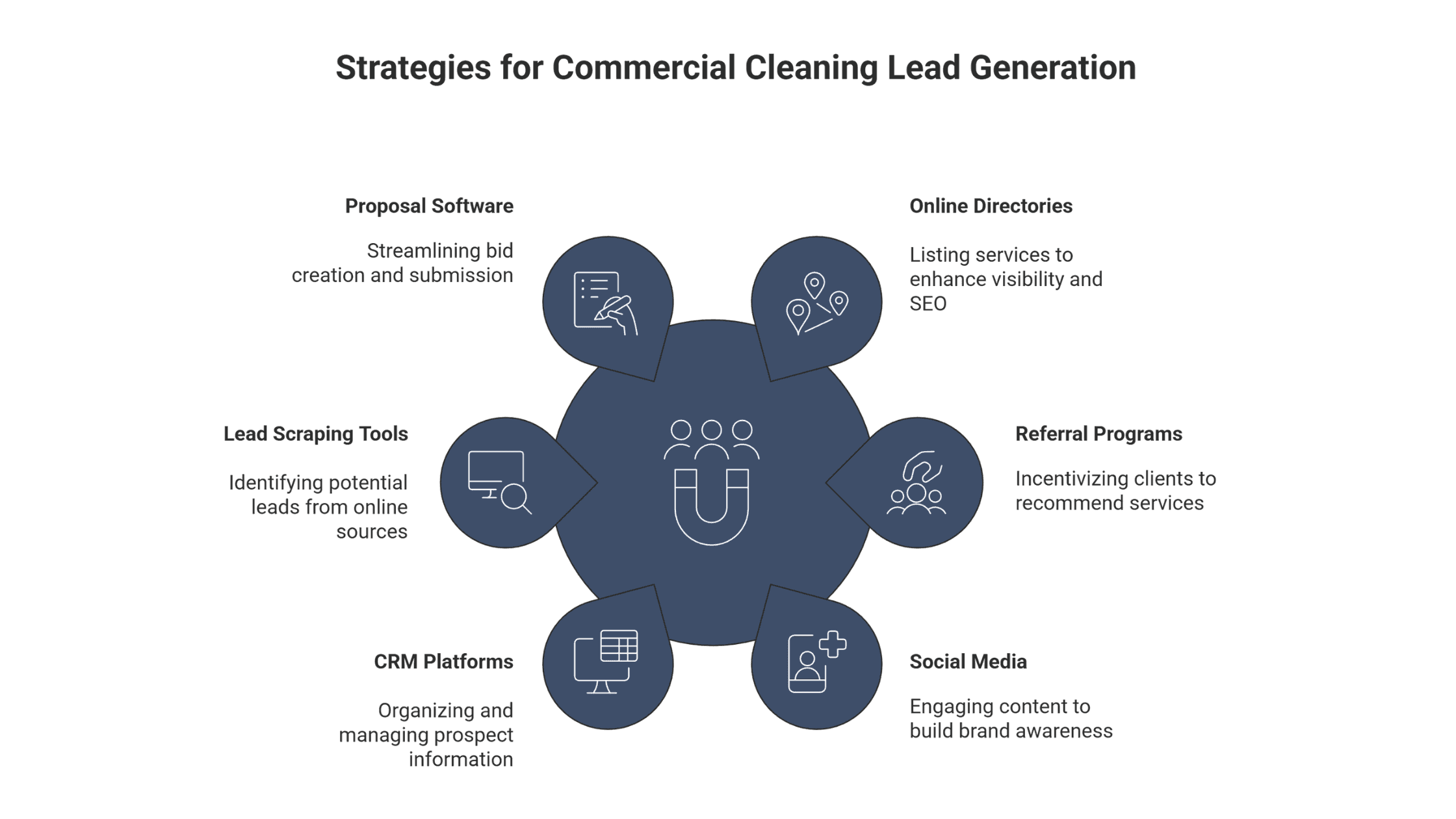
Choose CRM platforms designed for service businesses. Jobber offers field service functionality including scheduling, pricing, and mobile access. Zoho CRM provides customization for cleaning-specific workflows at accessible price points. HubSpot delivers free core functionality suitable for small operations. The platform matters less than consistent usage. A simple system used religiously outperforms sophisticated software left incomplete.
Digital Marketing Strategies for Commercial Cleaning Leads
Digital marketing provides scalable lead generation through channels reaching decision-makers where they research and evaluate cleaning contractors. The strategy combines visibility optimization for organic discovery, paid advertising for immediate lead capture, content creation for authority positioning, and direct outreach through professional networks.
Local SEO: Ranking for Commercial Cleaning Searches
Local SEO determines whether your business appears when facility managers search "commercial cleaning services near me" or "office cleaning [city name]." Visibility in local search results (Google's Map Pack and organic listings) generates consistent lead flow from prospects actively seeking services.
Optimization centers on several core tactics. Google Business Profile serves as the primary local visibility driver, requiring complete information including accurate business details, comprehensive service descriptions, regular photo uploads, and active review management. NAP consistency across all directories (matching Name, Address, and Phone number exactly on every listing) signals credibility to search algorithms. Location-specific content targets geographic keywords naturally while providing value to prospects researching local options.
The businesses dominating local commercial cleaning searches maintain updated profiles with diverse photos showcasing facility types they serve, respond to every review within 24 hours, and regularly publish location-specific content addressing facility manager concerns. For detailed local SEO implementation, review the Google Business Profile setup guide and GBP spam prevention tactics.
Pay-Per-Click Advertising for Immediate Lead Flow
Google Ads generates immediate lead flow by placing your services in front of prospects actively searching for commercial cleaning. The cleaning services sector demonstrates strong advertising performance with a 17.65% conversion rate, the highest among home services. Combined with an $8.50 average cost per click and a $46.99 cost per lead, paid search offers efficient economics for capturing qualified prospects.
Campaign success depends on proper structure matching search intent with relevant landing pages. Create separate campaigns for commercial versus residential services to control budget allocation and messaging. Within commercial campaigns, segment ad groups by facility type (office cleaning, medical facilities, retail locations) to deliver specific messaging addressing unique needs. Use location targeting to focus spending on service areas, avoiding wasted impressions from prospects outside your geographic range.
Structure campaigns around three core elements: facility type, service category, and geography. Use exact match and phrase match keywords to control spending and improve relevance. Broad match hemorrhages budget on irrelevant searches. Negative keywords prevent ads from showing for residential searches, job seeker queries, or supply purchases, saving budget for commercial service leads.
Landing pages must match ad messaging precisely. Ads promising office cleaning quotes should direct prospects to office cleaning pages, not generic homepages requiring navigation. Include clear calls-to-action for quote requests, emphasize facility-specific expertise, and provide trust signals through certifications, insurance documentation, and client testimonials.
Common Implementation Challenges:
The first 30 days typically reveal whether your Google Ads strategy will succeed or drain your budget. Budget depletion before optimization is the most common failure point. Most cleaning companies allocate $1,000-$2,000 monthly expecting immediate results, then panic when costs per lead hit $75-$100 in week one.
What actually happens: Your campaigns need 50-100 clicks minimum to gather enough conversion data for meaningful optimization. At $8.50 per click, that's $425-$850 just for learning phase. If your CPL exceeds $75 after 30 days and 100+ clicks, check these three issues first: broad match keywords bleeding budget to irrelevant searches, ads directing to your homepage instead of dedicated landing pages, or targeting geographic areas too wide for your actual service capacity.
Low-quality leads from broad match plague new campaigns. You'll see form submissions from homeowners, job seekers, or prospects 40 miles outside your service area. Solution: Start with exact match keywords only for your top 10 commercial terms, add "residential," "job," and "career" as negative keywords immediately, and use radius targeting no wider than 25 miles from your service center.
Timeline to profitability typically runs 60-90 days. Month one is learning, month two is optimization, month three is where positive ROI emerges. Companies that pause underperforming campaigns before 60 days never see the returns that come from systematic refinement.
Content Marketing That Attracts Decision-Makers
Content marketing establishes expertise and builds trust with facility managers during research phases before they're ready for sales conversations. Educational content answering common questions positions your company as the knowledgeable authority prospects want to work with rather than another vendor competing solely on price.
Focus content on decision-maker pain points rather than promotional messaging. Facility managers want to understand how to evaluate cleaning contractors, what questions to ask during facility walkthroughs, how to calculate fair pricing, and what performance metrics indicate quality service. Case studies demonstrate proven results with facilities similar to prospects' operations.
Case Study: Canadian Commercial Cleaning Company
A commercial cleaning company operating across multiple Canadian cities serving office buildings, retail locations, and educational institutions implemented systematic cold email campaigns in 2024 to reduce dependence on referral-only growth.
The company segmented outreach by industry type, company size, and location rather than blasting generic messages to purchased lists. Email content addressed specific pain points for each segment. Office managers received messaging about cleanliness and tenant satisfaction, retail prospects heard about customer-facing appearance standards, educational facilities got compliance and budget-focused content.
Each sequence included personalized subject lines A/B tested across segments, clear value propositions in opening lines, and specific calls-to-action offering facility assessments rather than generic "let's chat" requests. Follow-up sequences contacted non-responders at 3-day intervals for up to 5 touchpoints.
Results: Up to 30 qualified leads monthly from email campaigns alone. The company reported increased brand awareness within target markets and enhanced client relationships leading to referrals and repeat business from email-sourced accounts. While specific conversion rates and contract values weren't disclosed, the systematic approach transformed their pipeline from feast-or-famine referrals to predictable monthly lead flow.
LinkedIn Marketing for B2B Commercial Cleaning Leads
LinkedIn provides direct access to facility managers, property directors, and operations leaders who make cleaning service decisions. The platform's professional context suits B2B outreach far better than consumer-focused social networks, allowing targeted prospecting based on job titles, industries, and company characteristics.
Effective LinkedIn marketing balances outbound prospecting with inbound content strategy. Sales Navigator provides advanced search filters identifying prospects by job title, company size, industry, and location. Build targeted lists of facility managers or property directors within your service area working for companies matching your ideal client profile.
Connection requests should reference specific commonalities (shared industry groups, mutual connections, or recent company updates). Generic requests get ignored; personalized messages demonstrate genuine interest. Keep requests brief: "Hi Sarah, I noticed you manage facilities for healthcare organizations in [City]. I work with similar facilities on their cleaning operations and thought we should connect."
InMail allows direct messaging non-connections when using Sales Navigator or Premium accounts. InMails achieve response rates 300% higher than traditional email, making them effective for high-value prospects. Craft messages offering specific value (sharing industry research, offering facility management insights, or requesting brief calls to discuss operational challenges).
What Actually Happens in Month 1-3:
LinkedIn outreach follows predictable patterns most cleaning companies don't anticipate. Month one typically yields 20-30% connection acceptance rates when requests are personalized and targeted properly. Generic "I'd like to add you to my network" requests drop to 5-10% acceptance.
Your first outreach messages to new connections receive 5-8% response rates in the first 48 hours. This drops to 2-3% after one week. Timing matters because Tuesday through Thursday between 8-11 AM shows highest engagement based on facility manager activity patterns.
Most conversations require 5-7 touchpoints before prospects agree to calls. Facility managers are busy; your first message gets read but filed as "follow up later." Second message one week later providing value (industry article, facility management tip) reminds them you exist. Third message two weeks after that with specific call-to-action ("15-minute call to discuss your Q2 cleaning needs?") converts interested prospects.
Ghosting is normal. Expect 60-70% of initial responders to go silent after 1-2 exchanges. They're not rejecting you because facility managers get pulled into emergencies, budget freezes happen, priorities shift. Keep these connections in longer-term nurture campaigns. We've seen dormant LinkedIn connections convert 6-12 months after initial contact when their situations changed.
The facilities directors most receptive to LinkedIn outreach manage 3-10 locations. Single-location managers typically handle cleaning internally or have locked contracts. Enterprise-level directors (10+ locations) require longer relationship building before considering new vendors. Focus your initial outreach on the mid-market sweet spot.
Email Marketing Campaigns That Convert
Email marketing nurtures commercial cleaning leads through extended sales cycles with automated sequences providing value at each stage. The channel delivers exceptional economics because automated emails achieve 4X better conversion rates than standard campaigns, while email marketing generates $36-$40 for every dollar spent.
Success requires balancing education, relationship building, and conversion opportunities. Early-stage emails provide facility management tips or cleaning industry insights building expertise perception. Middle-stage emails address evaluation concerns with pricing transparency or proposal comparison guides. Late-stage emails offer limited-time incentives or simplified next steps reducing barriers to engagement.
Cold email sequences introduce your services to prospects who haven't expressed explicit interest. Effectiveness depends on precise targeting, personalized messaging, and multi-touch persistence. Structure sequences across 4-5 emails spaced several days apart. Initial emails introduce your company with specific value propositions addressing target industry pain points. Follow-up emails provide social proof through case studies, highlight specific service differentiators, or share educational resources.
Deliverability and List Hygiene Reality:
Email campaigns fail from deliverability issues more often than messaging problems. Your carefully crafted cold outreach never reaches prospects because it lands in spam folders or your domain gets blacklisted.
Bounce rates above 5% signal list quality problems. Hard bounces (invalid email addresses) damage sender reputation immediately. Soft bounces (full inboxes, temporary server issues) accumulate damage over time. Clean lists before campaigns by running validation services removing obvious bad addresses.
Spam trap avoidance requires careful list sourcing. Purchased lists frequently contain dormant addresses that major email providers converted to spam traps specifically to catch bulk senders. These traps don't belong to real people (they exist solely to identify spammers). Hit one spam trap and your domain reputation drops significantly.
Sender reputation maintenance requires warming new domains gradually. Don't blast 500 cold emails from a brand new domain on day one. Start with 10-20 daily sends to highly engaged contacts (past customers, personal connections) for two weeks. Gradually increase volume to 50, then 100, then 200 daily sends over 4-6 weeks. This gradual ramp signals legitimate sender behavior versus spam bot patterns.
The commercial cleaning companies with best email deliverability maintain separate domains for cold outreach versus customer communications. Your main business domain (@yourcompany.com) stays pristine for customer service, while a variation (@grow.yourcompany.com or @hello.yourcompany.com) handles prospecting. This isolation prevents cold campaign problems from affecting operational emails.
Traditional Lead Generation Methods That Still Work
Digital channels dominate marketing conversations, but traditional methods continue delivering strong ROI for commercial cleaning lead generation. Direct mail achieves a 112% median ROI, outperforming paid search and display advertising. Face-to-face networking at industry events generates relationship-based leads converting at higher rates than digital channels.
Direct Mail Campaigns Targeting Facility Managers
Direct mail cuts through digital noise reaching facility managers in physical form demanding attention. Research shows direct mail leads generate 600% more revenue than digital leads, while house lists average 5-9% response rates compared to typical digital response rates below 1%.
Target direct mail precisely using facility management databases or commercial property directories. Mail pieces should offer specific value (facility cleaning assessments, cost comparison tools, or cleaning protocol guides) rather than generic service promotions. Include clear response mechanisms with unique phone numbers or landing pages tracking campaign performance.
Integrate direct mail with digital follow-up for maximum impact. Send mail pieces, then follow up with email and LinkedIn outreach referencing the mailed content. This multi-channel coordination achieves a 118% lift in response rate compared to direct mail alone.
Networking with Commercial Property Associations
Industry associations connect you directly with facility managers and property directors attending conferences, local chapter meetings, and educational events. Building Service Contractors Association International (BSCAI) and International Facility Management Association (IFMA) host events where cleaning contractors meet decision-makers evaluating vendors.
Active participation builds relationships beyond transactional vendor-client dynamics. Present educational sessions at chapter meetings sharing expertise on cleaning trends or operational best practices. Sponsor association events gaining visibility while supporting industry development. Join committees contributing time toward industry advancement, creating peer relationships with facility management professionals.
Strategic Partnerships with Complementary Service Providers
Partnerships with complementary service providers create mutual referral networks expanding reach without direct marketing costs. Property management companies, commercial real estate brokers, HVAC contractors, and security companies all serve similar client bases with non-competing services.
Structure partnerships with clear referral arrangements. Formalize agreements specifying referral terms, lead sharing procedures, and any compensation arrangements. Create co-marketing materials highlighting combined service capabilities. Introduce key contacts from partner organizations to your clients, demonstrating relationship value encouraging reciprocal introductions.
Trade Show and Industry Event Participation
Trade shows provide concentrated access to facility managers and property directors researching service providers. The U.S. B2B trade show market reached $15.8 billion in 2024, with companies earning 4:1 ROI on average from exhibition investments.
Booth presence matters less than strategic engagement. Schedule meetings with prospects before events, using attendance as reason for outreach: "I'll be at IFMA next month. Let's schedule 15 minutes to discuss your facility challenges." Host educational sessions establishing expertise rather than simply manning booths. Sponsor networking events creating informal environments for relationship building.
Free and Low-Cost Lead Generation Tactics
Budget-conscious lead generation leverages existing assets and relationships rather than requiring significant financial investment. These tactics trade money for time, requiring consistent effort instead of advertising spend.
Leveraging Free Online Directories and Listing Sites
Free business directories provide backlinks supporting SEO while creating additional discovery points for prospects researching cleaning services. Priority listings include Google Business Profile, Bing Places for Business, Apple Business Connect, Yelp, and industry directories like Angi.
Maintain NAP consistency across all directories, ensuring Name, Address, and Phone number match exactly. Optimize each directory profile completely rather than submitting minimal information. Add comprehensive service descriptions, upload photos, list service areas, and specify operating hours.
Referral Programs That Turn Clients into Lead Sources
Referral programs systematically generate leads from satisfied clients who recommend services to peers. The economics prove compelling because referred clients have lifetime values 178% higher than non-referred clients, while referrals convert at 58% compared to just 3% for cold outreach.
Structure programs with clear incentives for successful referrals. Service discounts, gift cards, or cash payments reward clients for introductions resulting in signed contracts. Request referrals at optimal times (immediately after positive feedback, following contract renewals, or after resolving challenging situations demonstrating exceptional service).
Social Media Strategies Without Ad Spend
Organic social media builds brand awareness and demonstrates expertise without paid advertising. Focus efforts on LinkedIn for professional networking, with secondary presence on Facebook for community connections.
Content strategy should prioritize value over promotion. Share facility management tips, cleaning industry news, operational insights, or behind-the-scenes glimpses of service quality. Engage authentically with prospect and partner content through thoughtful comments and shares.
Commercial Cleaning Lead Generation Apps and Tools
Technology platforms streamline lead generation processes, automate repetitive tasks, and provide visibility into which activities generate actual results. William & Friends specializes in marketing operations systems connecting lead capture through closed contracts, providing full pipeline visibility for service businesses.
CRM and Lead Management Platforms
CRM platforms organize prospect information, track interactions, and automate follow-up sequences ensuring consistent communication. Jobber provides field service functionality including scheduling, pricing, and mobile access suitable for commercial cleaning operations. Zoho CRM offers customization at accessible price points for small-to-medium businesses. HubSpot provides free core CRM functionality adequate for early-stage operations.
Choose platforms integrating with other business tools (accounting software, marketing automation, or proposal generation systems). Prioritize ease of use over feature abundance because the best CRM is the one your team actually uses consistently.
Lead Scraping and Business Intelligence Tools
Lead scraping tools identify potential prospects by gathering business information from online sources. Outscraper specializes in Google Maps scraping, ideal for identifying commercial facilities by location and type. Apify provides versatile data collection across multiple platforms with 20+ integrations. Clay enriches scraped data with additional business intelligence while automating outreach workflows.
Proposal and Estimating Software
Proposal software streamlines bid creation, reducing time between facility walkthroughs and submitted proposals. Swept provides janitorial-specific features with comprehensive quoting tools tailored to cleaning contracts. ServiceM8 offers powerful workflow automations with strong mobile experience. Jobber excels at scheduling, pricing, and billing with intuitive interfaces.
Lead Qualification and Sales Process
Lead qualification separates genuine prospects from tire-kickers before investing significant sales time. Not every inquiry deserves equal attention because some leads represent immediate opportunities while others lack budget, authority, or actual need.
Pre-Qualifying Commercial Cleaning Prospects
Pre-qualification happens during initial contact, gathering information determining whether prospects merit full sales engagement. Key qualification questions include: What's your current cleaning arrangement (existing contractor or in-house staff)? What's prompting you to explore new options now? What decision-making process does your organization follow for vendor selection?
Budget qualification requires tactful probing. Instead of direct budget questions, describe typical pricing ranges for similar facilities: "Facilities like yours typically invest $8,000-$12,000 monthly for comprehensive cleaning. Does that align with your expectations?" This range-based approach reveals whether prospects have realistic budget understanding.
Conducting Effective Facility Walkthroughs
Facility walkthroughs assess cleaning requirements while demonstrating your expertise and professionalism. Arrive prepared with checklists, measuring tools, and documentation materials. Take detailed notes on square footage, surface types, high-traffic areas, specialized cleaning needs, and any challenging conditions affecting service delivery.
Use walkthroughs as consultative selling opportunities rather than just measurement exercises. Point out areas requiring special attention, explain recommended cleaning frequencies for different spaces, and identify potential issues current providers may overlook.
Creating Winning Proposals and Bid Responses
Proposals should clearly articulate value beyond price alone. Structure documents with executive summaries highlighting key differentiators, detailed scope descriptions leaving no room for interpretation, transparent pricing breakdowns by service area or frequency, and quality assurance processes ensuring consistent performance.
Customize proposals for each prospect rather than submitting generic templates. Reference specific facility characteristics observed during walkthroughs, address concerns mentioned in conversations, and highlight relevant experience with similar facilities.
Measuring and Optimizing Lead Generation Performance
Data-driven optimization separates high-performing lead generation from wasteful spending. Without measurement, you can't identify which channels deliver actual contracts versus which generate activity mistaken for results.
Key Metrics to Track for Commercial Cleaning Leads
Cost per lead measures efficiency of different acquisition channels. Calculate by dividing channel spending by leads generated: $2,000 in Google Ads generating 40 leads equals $50 cost per lead. Track this metric by source (SEO, paid ads, referrals, networking) revealing where to focus additional investment.
Conversion rates show how effectively leads become paying clients. Track conversions at each funnel stage: inquiry-to-consultation, consultation-to-proposal, proposal-to-contract. Low initial conversion rates suggest qualification problems (poor-fit leads entering your pipeline). Low later-stage conversion indicates sales process issues.
The average cost per lead across home services stands at $90.92, though cleaning services achieve lower costs at $46.99 through efficient paid advertising. Commercial cleaning's 17.65% conversion rate exceeds typical benchmarks, reflecting qualified lead flow from targeted marketing.
Calculating Cost Per Lead and Customer Acquisition Cost
Cost per lead (CPL) tracks lead generation efficiency: total marketing spending divided by leads generated. If $5,000 monthly spending generates 50 leads, CPL equals $100. Track CPL by channel to identify most cost-effective sources.
Customer acquisition cost (CAC) measures total sales and marketing investment required to close contracts: (total marketing + sales costs) divided by new customers acquired. If $10,000 monthly spending closes 10 contracts, CAC equals $1,000 per customer. Compare CAC to customer lifetime value because profitable businesses maintain CAC well below CLV.
Common Lead Generation Mistakes to Avoid
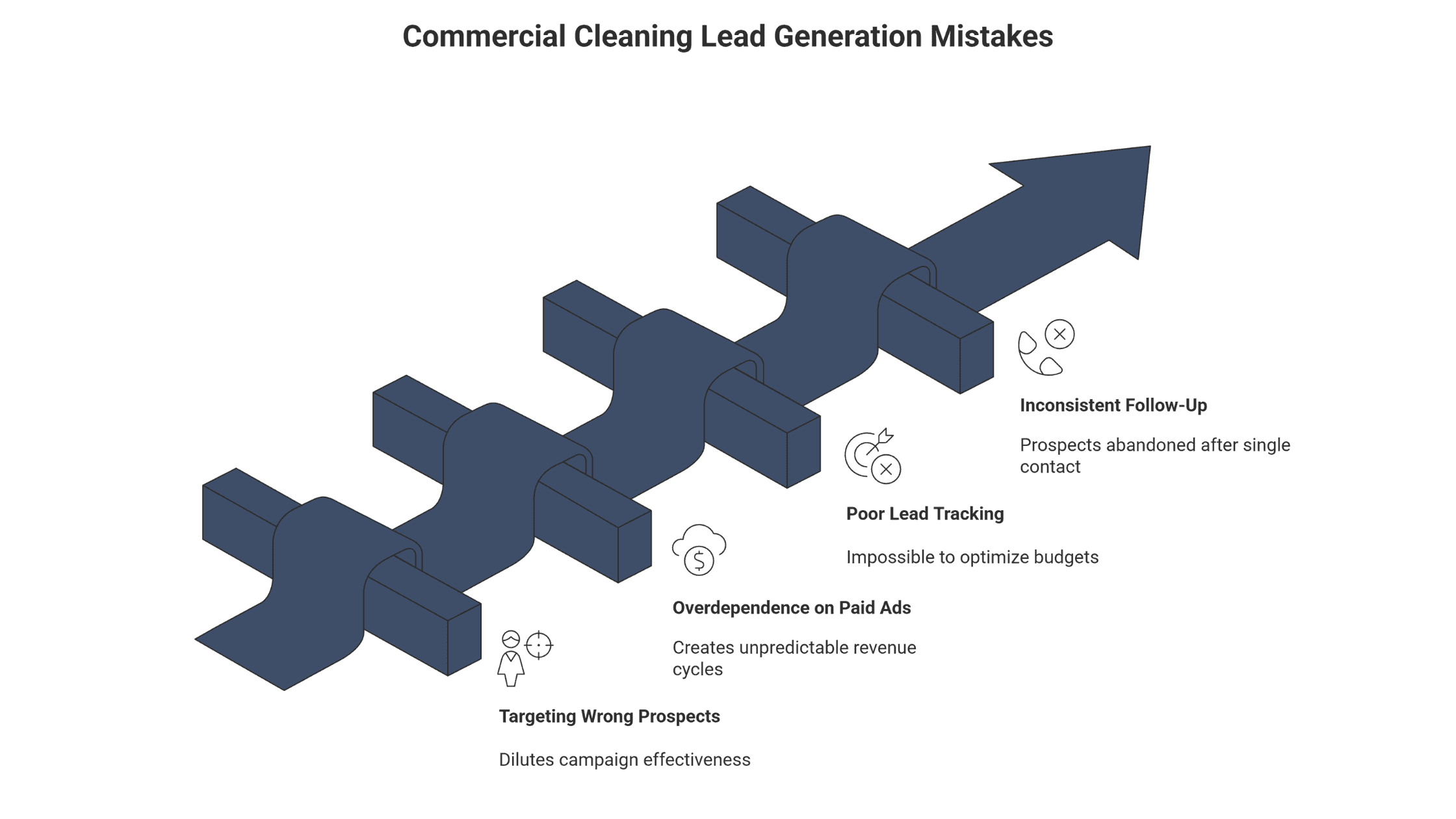
Commercial cleaning businesses repeatedly make predictable mistakes undermining lead generation effectiveness. The most damaging mistakes stem from targeting wrong prospects, inconsistent execution, price-focused positioning, and failure to track what actually works.
Targeting the Wrong Decision-Makers
The biggest mistake cleaning companies make is casting too wide a net instead of narrowing down to their ideal customer profile. Many businesses attempt to reach both office managers and homeowners with identical messaging, which dilutes campaign effectiveness and wastes budget across irrelevant prospects.
Create an ideal customer profile that segments your market into distinct categories (office cleaning leads, residential leads, and commercial janitorial leads). Use precise keyword targeting such as "office cleaning services near me" or "commercial cleaning company for schools" to ensure the correct customers find you.
Overdependence on Paid Advertising Without Organic Foundations
Many cleaning companies rely too heavily on paid ads (Google Ads, Facebook, LinkedIn), creating a precarious situation where leads dry up the moment ad spending stops. This creates unpredictable revenue cycles and makes profitability difficult, as cost per lead remains high without complementary organic channels supporting the pipeline.
Balance paid and organic lead sources by investing in long-term, low-cost channels simultaneously. Implement local SEO optimization to attract nearby clients, as this represents one of the most cost-effective lead generation strategies for geographically-bounded services.
Poor Lead Tracking and Attribution
Without proper lead tracking systems, cleaning companies cannot identify which channels actually drive conversions. Many businesses have no idea whether their leads come from social media, paid ads, referrals, or other sources, making it impossible to optimize budgets or replicate successful campaigns.
Implement a reliable CRM system to track leads from initial contact through conversion. Ensure your website includes forms, ads with unique tracking codes, and calling options that feed into your CRM, allowing you to monitor where each lead originates.
Inconsistent Follow-Up and Lead Nurturing
Past leads are frequently overlooked by cleaning businesses, even though many prospects who don't book immediately remain interested if the conversation continues. People often require multiple touchpoints before converting from lead to paying client, yet many companies abandon prospects after a single contact attempt.
Implement systematic email marketing campaigns that stay in touch with past prospects through useful cleaning tips, special offers, or service reminders. Research shows 90% of email marketing professionals report subscriber segmentation increases performance.
When to Consider Professional Lead Generation Services
Most commercial cleaning businesses eventually face the build-versus-buy decision: continue handling all lead generation internally or engage professional services accelerating results. The decision depends on growth goals, internal capabilities, and whether lead generation represents your primary bottleneck.
Signs Your Business Is Ready to Scale Lead Generation
Several indicators suggest readiness for professional lead generation support. First, you've proven your sales process converts leads consistently (closing 20-30% of qualified prospects who reach proposal stages). Second, operational capacity exists to service additional clients. Third, you've exhausted readily available internal options.
Research shows 63% of marketers rank lead generation as their biggest marketing challenge, making professional support valuable for proven businesses ready to scale.
Evaluating Lead Generation Service Providers
Evaluate providers based on industry expertise, performance guarantees, and transparent reporting. Commercial cleaning requires specific knowledge about facility manager purchasing behaviors, typical sales cycles, and effective messaging. Generic B2B lead generation firms lacking vertical expertise waste time learning your market.
Understand pricing models and performance expectations. Expect initial engagement within 2-4 weeks, qualified leads within 60-90 days, and meaningful pipeline impact within 3-6 months. Providers promising immediate results likely deliver unqualified prospects wasting sales time.
Hybrid Approach: Combining DIY and Professional Services
Hybrid models balance internal control with external expertise. Handle foundational activities internally (local SEO, customer referrals, existing network relationships) while outsourcing specialized tactics requiring unique expertise or significant time investment.
William & Friends helps service-based businesses implement this balanced strategy, providing specialized paid media and LinkedIn expertise while supporting internal teams with systems and analytics driving better decisions.
Creating Your 90-Day Lead Generation Action Plan
A structured 90-day action plan transforms lead generation from overwhelming challenge to manageable systematic execution. Break the plan into three 30-day phases focusing on foundation building, channel activation, and optimization.
Phase 1 (Days 1-30): Foundation & Infrastructure
Establish core systems before launching tactics. Define your ideal client profile with specificity (facility types, contract sizes, decision-maker characteristics). Set up CRM infrastructure with proper lead source tracking. Complete Google Business Profile optimization. Develop proposal templates streamlining bid creation. Create 3-5 case studies showcasing relevant experience.
Phase 2 (Days 31-60): Channel Activation
Launch 2-3 core lead generation channels based on your market and capabilities. If budget allows, start Google Ads campaigns targeting commercial cleaning keywords in your service areas. Begin systematic LinkedIn outreach to facility managers (connect with 10-15 prospects daily). Launch email nurture campaigns for existing prospect lists.
Phase 3 (Days 61-90): Optimization & Scaling
Analyze first 60 days identifying what's working and what needs adjustment. Review cost per lead by source, conversion rates at each stage, and customer acquisition costs. Double down on productive channels while pausing underperformers. Implement A/B tests improving best-performing tactics. Establish systematic follow-up cadences ensuring no leads fall through cracks.
Frequently Asked Questions About Commercial Cleaning Lead Generation
What's the best lead generation method for commercial cleaning businesses?
No single method works universally because effective strategies combine multiple channels matching your market, budget, and capabilities. Most successful commercial cleaning businesses balance local SEO for consistent organic leads, Google Ads for immediate pipeline fill, LinkedIn outreach for B2B relationships, and referral programs leveraging satisfied clients.
How much should I budget for commercial cleaning lead generation?
Budget allocation depends on growth goals and current revenue. New businesses often invest 15-20% of revenue in marketing while established companies maintain 5-10% for steady growth. Calculate acceptable customer acquisition costs based on average contract values and profit margins.
How long does it take to see results from lead generation efforts?
Timeline varies by channel. Google Ads and Local Services Ads generate leads within days once campaigns launch. Local SEO requires 3-6 months building authority before consistent organic lead flow. LinkedIn outreach produces qualified conversations within 4-6 weeks with persistent daily activity. Expect 90 days minimum building comprehensive systems generating predictable results across multiple channels.
Should I buy commercial cleaning leads from lead generation services?
Purchased leads rarely provide good ROI because they're often shared with multiple competitors, attract price shoppers, and lack proper qualification. Focus on generating your own leads through owned channels (SEO, paid ads, networking, referrals) creating sustainable systems rather than dependence on external lead suppliers.
How do I qualify commercial cleaning leads effectively?
Effective qualification assesses budget capacity, decision-making authority, facility fit, and purchase timeline. Ask direct questions during initial contact: "What's your current cleaning arrangement and what's prompting a change?" "Who approves vendor decisions at your organization?" "When do you need services to start?"
What's a realistic conversion rate for commercial cleaning leads?
Google Ads for cleaning services averages 17.65% conversion from click to lead, significantly exceeding most industries. Cold outreach converts at 3% while referrals achieve 58% conversion rates, demonstrating the power of qualified warm introductions. From qualified lead to signed contract, expect 20-30% conversion with professional sales execution.
Conclusion
Commercial cleaning lead generation requires systems thinking, not scatter-shot tactics hoping something sticks. The businesses that build predictable growth connect every marketing dollar to measurable outcomes, track which channels actually deliver paying contracts, and systematically nurture prospects through long sales cycles common in commercial services.
The fundamentals start with crystal-clear ideal client profiles guiding where to focus limited resources. Layer CRM infrastructure tracking leads from first contact through signed contracts. Deploy balanced channel mixes combining immediate tactics like Google Ads with long-term assets like local SEO and referral systems. Qualify prospects rigorously before investing sales time. Measure what matters (cost per lead, conversion rates, customer acquisition costs) using data to double down on what works while cutting what doesn't.
William & Friends partners with service-based businesses implementing these systems with full-funnel clarity and operator-focused execution. Our approach emphasizes measurement, systematic improvement, and connecting marketing activity to actual revenue rather than vanity metrics.
Ready to build lead generation systems that actually work?
Talk to William & Friends about creating predictable pipeline growth through disciplined execution and data-driven optimization.
Frequently asked questions
William Turner
Hey, I’m William, founder of William & Friends in Denver. We help service businesses get found, get chosen, and get booked. SEO, CRO, and ads tied to clean reporting. Recent wins include 908% year-over-year traffic for a commercial laundry brand and 39% more revenue attributed to organic search for a Denver studio. I write about conversion math, offer-to-channel fit, and operator-grade marketing. If you want the truth about where your pipeline leaks, grab the free marketing audit.
Hey, I’m William, founder of William & Friends in Denver. We help service businesses get found, get chosen, and get booked. SEO, CRO, and ads tied to clean reporting. Recent wins include 908% year-over-year traffic for a commercial laundry brand and 39% more revenue attributed to organic search for a Denver studio. I write about conversion math, offer-to-channel fit, and operator-grade marketing. If you want the truth about where your pipeline leaks, grab the free marketing audit.
Success Studies
Growth Happens Here
See how our strategies have helped clients dominate their markets: