

Key Points
-
Start with client clarity: Define your niche, specialty areas, and the exact problems you solve so your messaging stops sounding generic.
-
Build a website that converts: Your site should quickly answer “Are you for me?”, clarify fees/insurance/availability, and make contacting you frictionless.
-
Win local search first: Local SEO and a fully optimized Google Business Profile are the fastest path to consistent, high-intent discovery.
-
Use directories strategically: Psychology Today is not enough. Add targeted directories (plus consistent NAP) to expand reach and reduce reliance on one channel.
-
Trust is the conversion lever: Reviews, clear positioning, and helpful content do more “selling” than aggressive promotion ever will.
-
Content = compounding visibility: Publish fewer, better pieces that answer real client questions and support SEO, socials, and email.
-
Relationships still win: A referral network and community partnerships create durable, low-cost lead flow that aligns with clinical values.
-
Choose platforms on purpose: Pick 1–2 social platforms your ideal clients actually use, then post consistently with boundaries.
-
Measure like an operator: Track inquiry volume, conversion rate, and client source. Review monthly, adjust quarterly, don’t thrash week to week.
-
Run a 90-day plan: Foundation (days 1–30), visibility (31–60), relationship momentum (61–90), then iterate.
Why Marketing Your Private Practice Feels Different (And Why That’s Your Advantage)
Marketing your private practice probably triggers feelings you don’t experience in clinical sessions. Many practitioners describe a sense of vulnerability when promoting their services, as if marketing contradicts the caring, client-focused identity they’ve cultivated.
The practitioners who successfully grow their practice make a fundamental mindset shift. They recognize that marketing therapists isn’t about convincing people they need help. It’s about ensuring the right people can find you when they’re already searching for support. Your hesitation about self-promotion actually signals something valuable: you care deeply about authentic connection.
Your professional training gives you an advantage that traditional marketers lack. You already understand human behavior, motivation, and the importance of meeting people where they are. These skills translate directly into creating marketing messages that resonate. When you frame private practice marketing as an extension of your service rather than a departure from it, the entire process becomes more natural and aligned with your values.
Understanding Your Ideal Client Before You Market
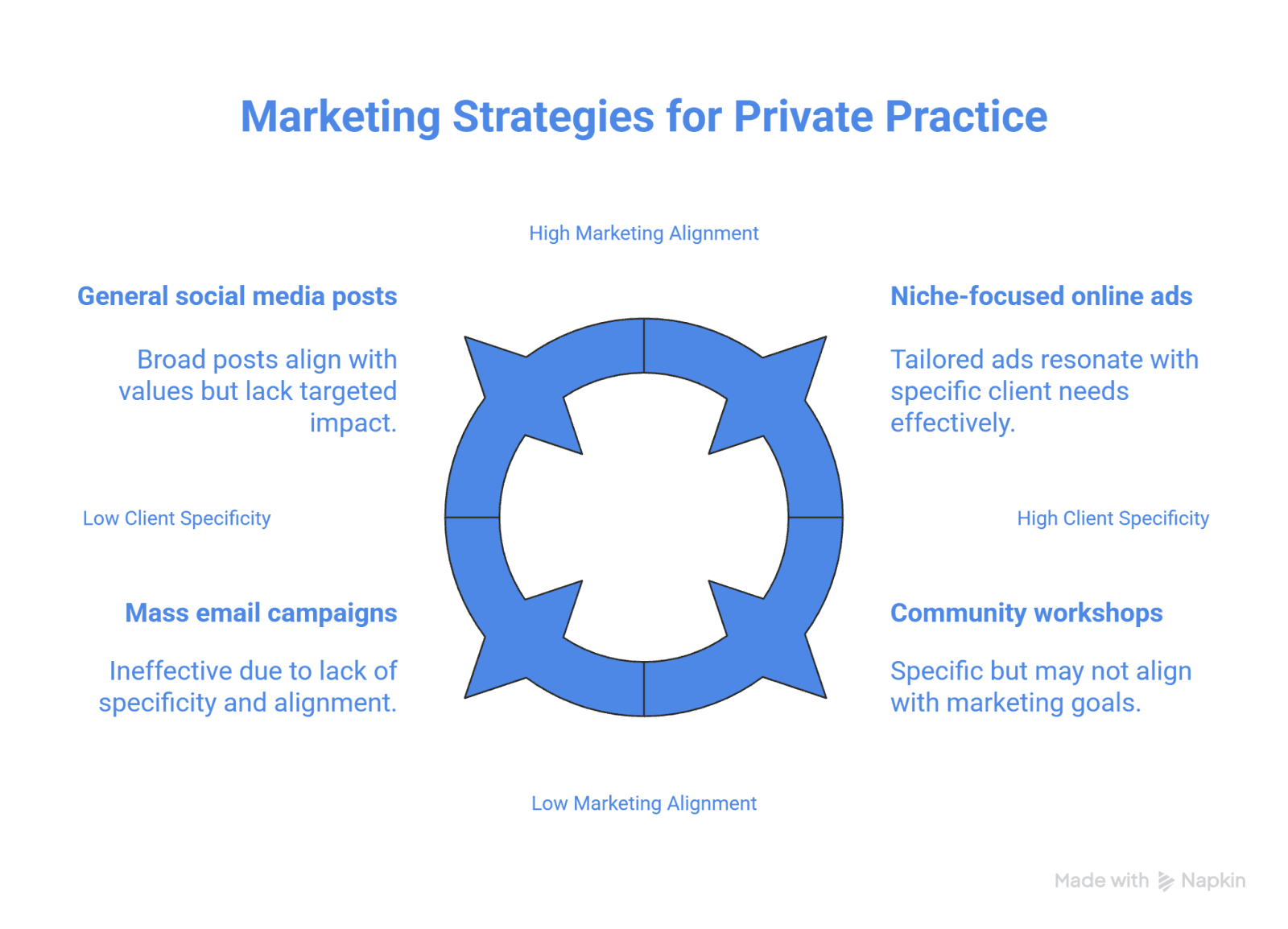
The most effective marketing for private practice starts with clarity about who you serve best. Without this foundation, your marketing efforts scatter across too many directions, diluting your message and exhausting your resources.
Define Your Niche and Specialty Areas
Your clinical training prepared you to work with various populations and presenting issues. However, marketing your private practice effectively requires you to narrow your focus. The practitioners who stand out in crowded markets have identified specific niches that align with their skills, interests, and experience.
Consider what types of clients energize you most. Think about the populations where you’ve achieved your best outcomes. Reflect on the issues that genuinely interest you and where you’ve invested additional training. Your niche should represent the intersection of your capabilities, your passion, and market demand.
Specialty areas might include specific age groups, particular therapeutic approaches, distinct presenting concerns, or unique populations. The more specific you become, the easier it is to craft marketing messages that speak directly to your ideal clients’ experiences. This specificity also helps you build your practice reviews and reputation as the go-to expert for particular issues.
Research Where Your Ideal Clients Are Looking for Help
Once you’ve identified your niche, you need to understand where these potential clients search for help. The data is clear:74% of patients begin their search for healthcare providers online, using search engines, health websites, or provider sites. For behavioral health specifically,81% use online channels to identify options before contacting a provider.
Different populations use different resources within that digital landscape. Younger clients might start with Instagram searches or TikTok recommendations. Parents often turn to school counselors, pediatricians, or local parenting groups. Corporate professionals might search through their employee assistance programs or LinkedIn networks.
Investigate the online platforms your ideal clients frequent. Join relevant online communities where they discuss their challenges. Note which local organizations and resources they trust. Pay attention to the language they use when describing their struggles. This research informs not just where you market, but how you communicate.
Understanding these search patterns helps you allocate your marketing budget effectively. Rather than spreading thin across every possible platform, you concentrate resources on the channels that actually reach your ideal clients.
Create Client Personas That Guide Your Marketing Decisions
Client personas transform abstract target markets into specific individuals you can visualize and understand. These detailed profiles go beyond basic demographics to include psychographics, behavioral patterns, pain points, and decision-making processes.
Start with a primary persona representing your most common ideal client. Give this person a name, age, and background. Describe their daily life, challenges, goals, and fears. Identify what might prevent them from seeking help and what would motivate them to reach out. Consider their preferred communication style, their trusted information sources, and their decision-making process when selecting a practitioner.
Create secondary personas for other significant client segments. These detailed profiles help you craft marketing materials that speak directly to specific concerns. When writing website copy, creating social media content, or developing email sequences, you can ask whether your message resonates with Sarah, the overwhelmed working mother, or David, the executive struggling with burnout.
Building Your Marketing Foundation
Strong private practice marketing requires solid foundational elements that work together to establish your credibility and make it easy for ideal clients to choose your services.
Develop a Professional Website That Converts Visitors to Clients
Your website serves as the central hub of your marketing for therapists efforts. When potential clients discover you through search, directories, or referrals, they almost always visit your website before making contact. Research shows thatpatients use 3-4 distinct online resources before booking an appointment, and58% visit both third-party sites and the provider’s own website before deciding to book.
Effective practice websites balance professionalism with warmth. Your site should immediately clarify your specialty and ideal client, eliminating confusion about whether you’re the right fit. Include clear descriptions of your services, your approach, and what clients can expect when working with you.
Conversion-focused websites guide visitors through a logical journey from learning about your services to taking action. Strategic placement of calls to action, simplified contact forms, and clear next steps reduce friction in the decision-making process. According toa 2024 mental health consumer report, over 70% of people looking for therapy won’t contact a provider if insurance information, fees, or availability are unclear online.
Healthcare and professional service websites that are well-optimized for local traffic and user experience typically see conversion rates in the 3-8% range for lead forms and tracked calls, with top performers achieving higher rates for local and branded queries.
Craft Your Unique Value Proposition
Your unique value proposition articulates what distinguishes your practice from others serving similar populations. This isn’t just a list of your credentials or therapeutic approaches. It’s a clear statement of the specific transformation or outcome clients can expect when working with you, and why your particular combination of skills, experience, and approach makes you uniquely qualified to deliver these results.
Developing this proposition requires honest reflection on what you do differently or better than other practitioners. Perhaps you integrate specific training that few local providers possess. Maybe you’ve personal experience that gives you unique insight into your clients’ challenges. Your approach might combine methodologies in a distinctive way, or you might offer flexible formats that improve accessibility for your ideal clients.
Focus on the specific outcomes your ideal clients seek and how your unique combination of qualities helps them achieve these results more effectively. Generic statements about being caring or professional don’t differentiate you because clients expect these qualities from any competent practitioner.
Establish Your Professional Brand Identity
Private practice branding extends beyond your logo and color scheme, though these visual elements matter. Your brand encompasses the entire experience clients have with your practice, from their first website visit through ongoing therapeutic relationships.
Consider how you want clients to feel when they interact with your practice. Your brand should reflect both your professional expertise and your authentic personality. The language you use, the imagery you select, the tone of your communications all contribute to this cohesive identity. Avoid borrowing brand elements that feel inauthentic just because they seem professional or popular.
Strong brands make decision-making easier. When creating content, designing materials, or communicating with clients, you can evaluate whether each choice aligns with your established brand identity
Essential Digital Marketing Strategies for Private Practices
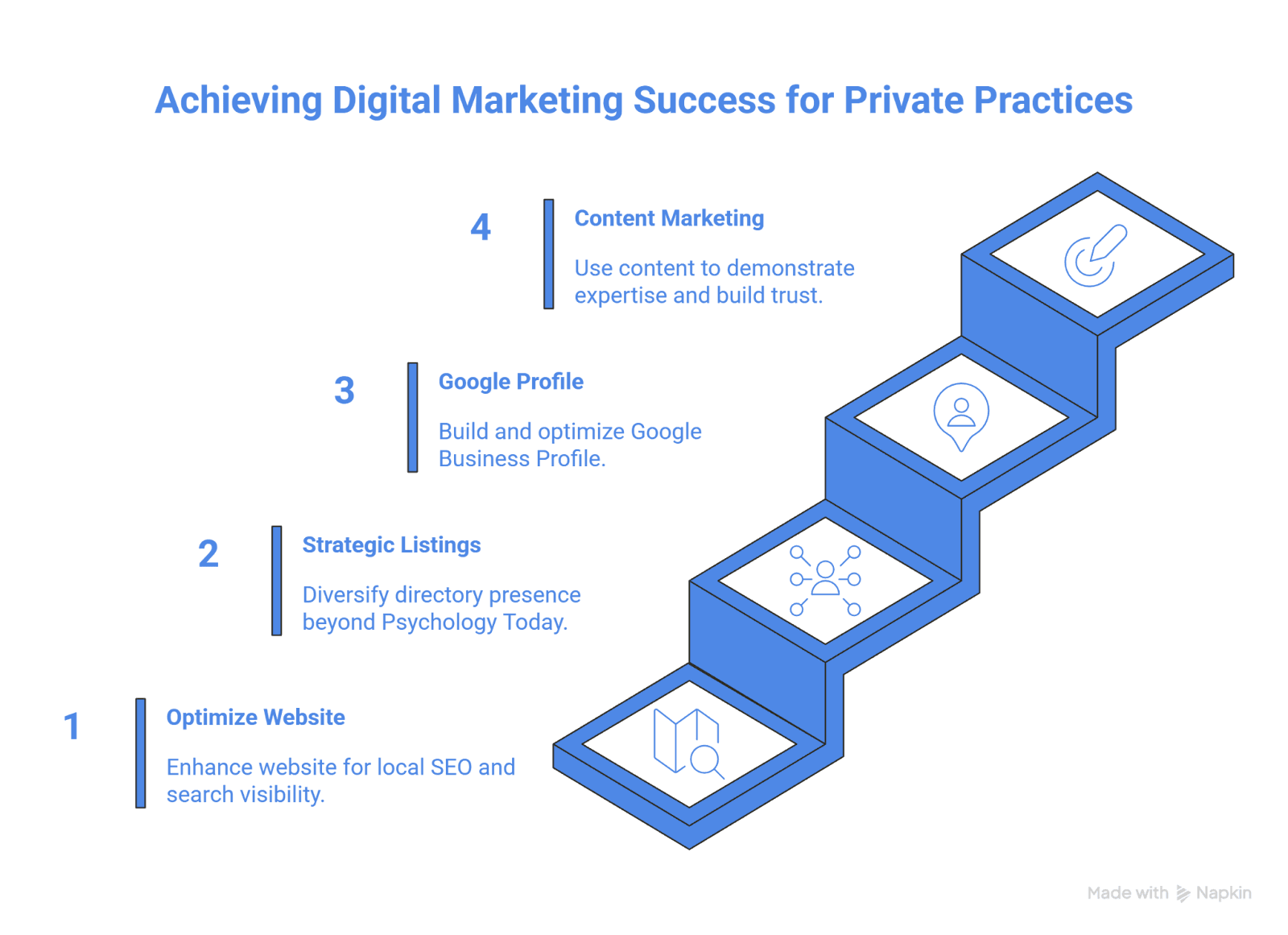
Digital marketing provides cost-effective ways to grow therapy practice visibility and attract ideal clients. The key is implementing strategies that work together to build your online presence and make it easy for potential clients to find and choose your services.
Optimize Your Website for Local SEO and Search Visibility
Most private practice clients search for services in their local area. Research shows that87% of consumers use Google to evaluate local businesses, and healthcare is one of the top three categories for local searches. Within healthcare specifically,66% of patients filter by location or distance first, before viewing other details such as specialty or credentials.
Local SEO ensures your practice appears when potential clients search for terms like “therapist near me” or “anxiety counseling in [your city].”
Keyword Research and Implementation
Start by identifying location-specific keywords your ideal clients actually use. Research patterns like “[service] + [city/neighborhood]”, “[condition] therapist near me”, and “[specialty] counseling in [area]”. Tools like Google Keyword Planner, Ubersuggest, or paid platforms like SEMrush can reveal search volumes and competition levels for these terms.
Incorporate these keywords naturally throughout your website content. Include your city, neighborhood, or region in page titles, H1 headings, and service descriptions. Create dedicated pages for each service you offer, optimizing each for relevant search terms. For example, if you specialize in trauma therapy in Brooklyn, create a page titled “Trauma Therapy in Brooklyn” with content addressing local clients’ specific concerns.
On-Page Technical Optimization
Each service page should follow a clear structure:
-
Title tag with primary keyword (under 60 characters): “Anxiety Therapy in Austin | [Your Practice Name]”
-
Meta description with location and benefit (under 160 characters)
-
H1 heading using your primary keyword naturally
-
H2 and H3 subheadings incorporating related terms and addressing client questions
-
Local landmarks or neighborhoods mentioned in body copy
-
Embedded Google Map of your location
-
Clear calls-to-action above the fold and at the end of content
Schema Markup for Therapists
Schema markup helps search engines understand your practice information and can display key details directly in search results, improving click-through rates. Implement these schema types on your website:
-
LocalBusiness or MedicalBusiness schema with your NAP (name, address, phone)
-
Physician or MedicalOrganization schema if applicable
-
Service schema for each therapy service offered
-
FAQPage schema on pages with frequently asked questions
You can add schema using plugins like Schema Pro or Yoast SEO, or by manually adding JSON-LD code to your site. Test your implementation using Google’s Rich Results Test tool.
Local Link-Building Tactics
Build local authority through strategic link acquisition:
-
Get listed in local business directories and chamber of commerce sites
-
Write guest posts for local wellness blogs or community publications
-
Participate in local mental health awareness events and secure coverage
-
Partner with complementary local businesses (yoga studios, wellness centers) for reciprocal links
-
Sponsor local events or organizations relevant to your ideal clients
Case Example: Local SEO Success
A solo trauma and anxiety therapist implemented comprehensive local SEO in a competitive city market. The strategy included optimizing their Google Business Profile with detailed services and photos, creating city-specific service pages with local keywords, and publishing regular blog content addressing anxiety and trauma questions.
Within six months, organic traffic increased by over 100% year-over-year. The practice moved from low or non-existent visibility to appearing in top local results and the map pack for key terms like “[therapy type] + [city]” and “trauma therapist near me.” Most importantly, inquiries increased enough to fill their caseload and create a waitlist within the first year, shifting from inconsistent word-of-mouth to a steady stream of weekly inquiries primarily from Google search.
Leverage Strategic Directory Listings Beyond Psychology Today
While Psychology Today remains popular for finding therapists, diversifying your directory presence expands your reach to potential clients who use other resources. Different directories attract different populations, and being present across multiple platforms increases the likelihood that your ideal clients discover your practice.
Research directories specific to your niche or specialty area. Directories focused on particular therapeutic approaches, populations, or issues often attract more targeted potential clients. Key platforms to consider include:
-
Google Business Profile (essential)
-
Healthgrades, Zocdoc, Vitals, WebMD (general healthcare)
-
GoodTherapy, TherapyDen (therapy-specific)
-
Insurance provider directories if you’re in-network
-
LGBTQ+ directories if you specialize in that community
-
Professional organization directories (APA, NASW, state associations)
Maintain consistency across all directory listings. Use the same profile photo, practice description, and contact information everywhere. This consistency reinforces your professional brand and helps potential clients recognize your practice across platforms. Ensure your NAP (name, address, phone) matches exactly across all platforms, as discrepancies can confuse search engines and hurt local rankings.
Build an Effective Google Business Profile
Your Google Business Profile significantly impacts your local search visibility and often appears before your website in search results. This free tool allows you to manage how your practice appears across Google services, including Google Search and Google Maps.
Complete Profile Optimization
Fill out every section of your profile thoroughly:
-
Categories: Select your primary category carefully (e.g., “Counselor,” “Psychotherapist,” “Marriage Counselor”). Add secondary categories for specialties.
-
Services: List specific services with localized phrasing (e.g., “EMDR therapy in Denver,” “couples counseling for communication issues”).
-
Business description: Use your 750 characters to include primary local keywords, your specialties, and trust markers like years in business or insurance accepted.
-
Attributes: Enable relevant attributes like “online appointments,” “wheelchair accessible,” or “LGBTQ+ friendly.”
-
Hours: Keep regular and holiday hours updated.
-
Photos: Add high-quality photos of your office exterior, waiting area, and therapy room if appropriate. Include at least 5-10 images and update quarterly.
Active Content Strategy
Treat your GBP as a content channel, not just a static listing. Post weekly updates, mental health tips, FAQs, or announcements tied to local events or awareness months. These posts keep your profile active and can improve visibility in local search results.
Add UTM parameters to your website and appointment URLs in GBP to track conversions in Google Analytics. Enable the “Book appointment” or “Request consultation” button if you use compatible scheduling software.
Managing Reviews
Reviews dramatically influence potential clients’ decisions. Research shows that83% of patients consider online reviews important when choosing a healthcare provider, and47% won’t consider a provider with less than a 4-star rating. For behavioral health specifically,71% read online reviews before contacting a therapist, and nearly half ruled out at least one provider due to poor or missing reviews.
Encourage satisfied clients to leave Google reviews through simple, ethical processes:
-
Mention at natural transition points like successful treatment completion
-
Include review requests in post-session follow-up emails
-
Provide a direct link to your Google review page
-
Never offer incentives or pressure clients
Respond professionally to all reviews, both positive and negative. Thank reviewers for positive feedback. Address negative reviews thoughtfully, acknowledging concerns while maintaining confidentiality. Your response demonstrates professionalism to potential clients reading reviews.
Use Content Marketing to Demonstrate Your Expertise
Content marketing positions you as a trusted expert while providing genuine value to potential clients. When you consistently share helpful information that addresses your ideal clients’ concerns, you build credibility and trust before prospects ever contact you.
Create blog posts, articles, or videos that answer questions your ideal clients commonly ask. Address concerns that might prevent someone from seeking help. Explain your therapeutic approaches in accessible language. Share insights about mental health topics relevant to your niche. This content serves multiple purposes: it improves your website’s search visibility, demonstrates your expertise, and helps potential clients understand how therapy might help their specific situations.
Focus on quality over quantity. One comprehensive, genuinely helpful piece of content creates more impact than several superficial posts. Share your content across your social media channels and email newsletter to maximize its reach.
Case Example: Content-Driven Growth
A group counseling practice implemented a mixed digital marketing strategy including local SEO, content marketing, and Google Ads. They created location-specific pages for “counselor [city]” and “teletherapy [city],” plus regular blog posts answering common client questions like “Benefits of Counseling.”
They later expanded to video content on topics like “Why Choose Counseling,” hosted on HIPAA-compliant platforms. Google Ads provided instant visibility and helped fill the schedule within the first few months, while SEO and content built momentum over the following year. The surge in inquiries from both local and teletherapy clients allowed the practice to fill their schedule, expand services, and hire additional staff. Rankings for both local terms and broader “online counseling” searches increased inquiry volume from clients in and outside their immediate area.
Relationship-Based Marketing That Feels Natural
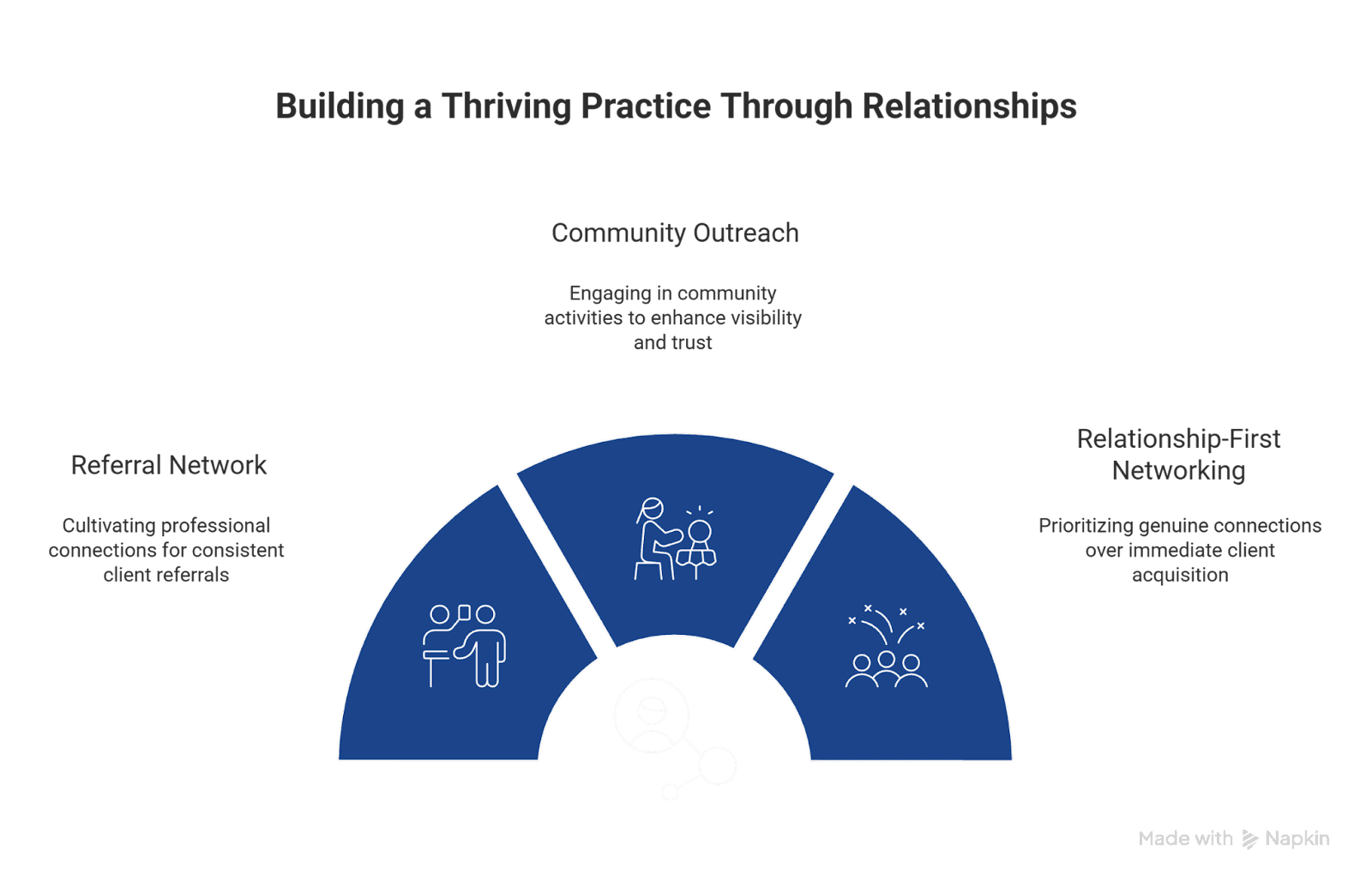
The most sustainable marketing strategies for growing your practice leverage relationships and community connections. These approaches feel more comfortable for many practitioners because they align with the relational skills you use in clinical work.
Build and Nurture a Referral Network
Professional referral networks remain one of the most effective ways to grow private practice client bases. Other professionals who regularly encounter people needing your services can become consistent referral sources when you build genuine relationships with them.
Identify professionals whose clients might need your services. Primary care physicians, psychiatrists, school counselors, attorneys, clergy, and other therapists with different specialties all encounter people who could benefit from your expertise. Reach out to introduce yourself and your services. Explain clearly who you serve and how you help them.
Nurture these relationships through regular communication. Send updates about your practice, availability, or new specialties. Refer clients to these professionals when appropriate, creating reciprocal relationships. Express gratitude for referrals promptly and provide feedback about outcomes when ethically appropriate.
Engage in Community Outreach and Partnerships
Active community involvement builds your practice visibility while contributing to community wellbeing. When you share your expertise in community settings, you demonstrate your commitment to helping others while naturally attracting potential clients who resonate with your approach.
Consider offering workshops, presentations, or consultations to community organizations serving your ideal clients. Schools, workplaces, religious organizations, and community centers often welcome mental health education. These presentations position you as an expert while allowing potential clients to experience your personality and approach firsthand.
Partner with complementary service providers to create value for shared audiences. Collaborate with yoga studios, wellness centers, nutritionists, or coaches whose clients might benefit from your services.
Network Without the Awkwardness: Relationship-First Approaches
The most effective networking happens when you approach it as relationship-building rather than client acquisition. Focus on genuine connection and mutual support rather than immediate outcomes.
Attend professional gatherings, community events, or interest groups where you might naturally meet potential referral sources or ideal clients. Approach conversations with curiosity about others rather than rehearsed pitches about your practice. Listen for opportunities to provide value, whether through information, resources, or connections to others in your network.
Follow up meaningfully after initial meetings. Send articles relevant to conversations you had, make introductions that could benefit someone, or simply reach out to continue the discussion. These authentic gestures build relationships that often lead to referrals over time.
Social Media Marketing for Private Practices
Social media offers unique opportunities to connect with potential clients and referral sources while demonstrating your personality and approach. However, effective therapy marketing on social platforms requires strategic choices about where to invest your energy and how to maintain professional boundaries.
Choose the Right Platforms for Your Ideal Client
Different social media platforms attract different demographics and serve different purposes. Rather than trying to maintain a presence everywhere, focus on the platforms where your ideal clients actually spend time.
LinkedIn works well for reaching professional audiences and connecting with referral sources. Instagram and Facebook reach diverse populations and allow for varied content formats. TikTok attracts younger audiences and rewards authentic, educational content. YouTube serves people searching for in-depth information about mental health topics.
Start with one or two platforms and build consistent presence before expanding. Each platform has different norms, content formats, and algorithms. Mastering one platform yields better results than mediocre presence across many.
Create Valuable Content That Educates and Attracts
Social media content for therapy marketing should prioritize providing value over self-promotion. When you consistently share helpful information, tips, and insights, you attract people interested in the topics you address.
Share educational content that addresses common concerns in your niche. Explain therapeutic concepts in accessible language. Offer practical strategies people can implement immediately. Challenge misconceptions about mental health or therapy. This content positions you as a helpful expert rather than just another business seeking clients.
Balance educational content with posts that reveal your personality and approach. Share your perspective on mental health news or trends. Discuss what you find rewarding about your work. Show your office space or discuss what clients can expect in first sessions.
Navigate Ethics and Boundaries on Social Media
Maintaining professional boundaries on social media requires thoughtful policies and consistent implementation. Never discuss current clients or specific clinical situations on social media, even without identifying information. Avoid connecting with current clients on personal social media accounts. Be cautious about accepting friend or follow requests from former clients.
Respect client confidentiality rigorously in all online interactions. Don’t acknowledge therapeutic relationships publicly, even if clients have identified themselves as your clients online. Be mindful that anything you post publicly reflects your professional judgment and could influence how current or potential clients perceive you.
Client Reviews and Testimonials That Build Trust
Positive reviews and testimonials significantly influence potential clients’ decisions about choosing a therapist. These authentic endorsements from people who’ve experienced your services provide social proof that complements your professional credentials and marketing messages.
How to Request and Collect Client Testimonials Ethically
Gathering testimonials requires sensitivity to the therapeutic relationship and ethical guidelines. You cannot pressure clients for reviews, and you must respect their right to decline without affecting the therapeutic relationship.
Consider requesting feedback at natural transition points, such as when clients complete treatment or achieve specific goals. Make requests generally rather than asking specific clients, perhaps through email to all current or former clients or signs in your waiting room. Provide clear, simple instructions for leaving reviews on your preferred platforms.
Thank clients who provide testimonials, but never offer incentives that could compromise the authenticity of reviews. Use testimonials strategically on your website, marketing materials, and social media while respecting client confidentiality.
Manage Your Online Reputation Across Platforms
Your online reputation extends across review sites, social media platforms, directory listings, and search results. Actively monitoring and managing this reputation helps you understand how others perceive your practice and address any concerns that arise.
Regularly search your practice name and your name to see what potential clients find when researching you. Set up Google Alerts to notify you when your practice is mentioned online. Check reviews on Google, Yelp, Healthgrades, and any directories where you maintain listings.
Respond promptly and professionally to all reviews, both positive and negative. Thank reviewers for positive feedback. Address negative reviews thoughtfully, acknowledging concerns while maintaining confidentiality and professionalism. View negative reviews as opportunities to demonstrate your professionalism and commitment to client satisfaction.
Email Marketing for Client Retention and Referrals
Email marketing remains one of the most effective channels for maintaining relationships with current clients, staying connected with former clients, and nurturing referral relationships. Unlike social media, where algorithms control visibility, email reaches your audience directly.
Build Your Email List From Your Existing Network
Your email list grows from connections you’ve already established. Start by compiling email addresses you’ve collected through website contact forms, consultation requests, workshop attendees, networking contacts, and current or former clients who’ve consented to marketing communications.
Add signup opportunities throughout your online presence. Include email subscription forms on your website, offering valuable resources like guides, worksheets, or articles in exchange for email addresses. Mention your newsletter on social media and directory profiles.
Maintain list hygiene by respecting unsubscribe requests immediately and removing inactive subscribers periodically. A smaller list of engaged subscribers delivers better results than a large list of uninterested recipients.
Create Email Sequences That Nurture Relationships
Strategic email sequences help you maintain meaningful contact without constantly creating new content. These automated series guide subscribers through planned journeys, whether welcoming new subscribers, nurturing potential clients, or staying connected with former clients.
Create a welcome sequence for new subscribers that introduces your approach, shares helpful resources, and explains how you can help their specific concerns. Send regular newsletters to maintain relationships with your entire list. Share new blog posts, mental health tips, updates about your practice, or relevant mental health awareness information. Keep emails concise and focused on providing value rather than constantly promoting your services.
Creating Your Private Practice Marketing Plan
A comprehensive private practice marketing plan transforms general marketing ideas into actionable strategies aligned with your practice goals.
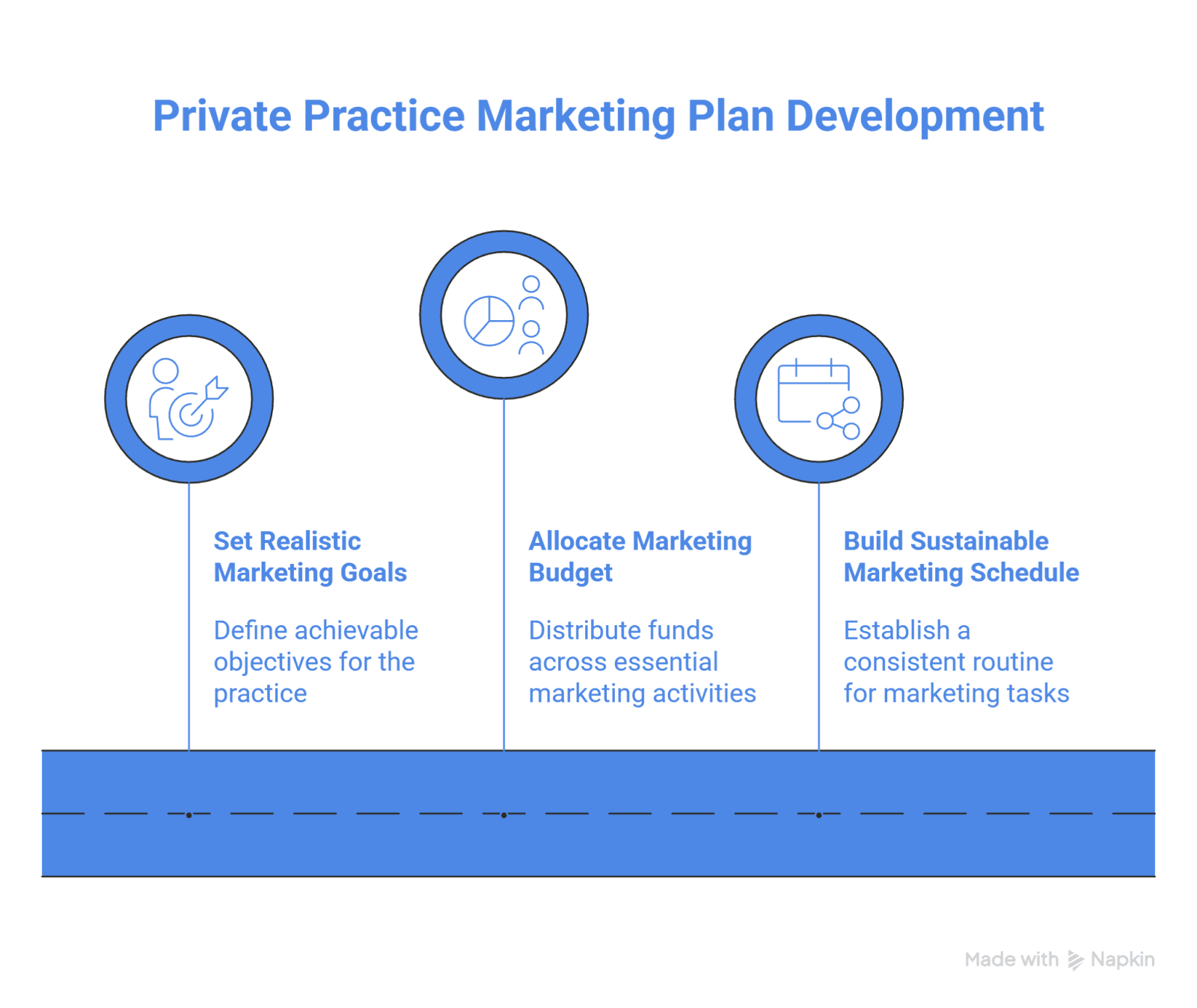
Set Realistic Marketing Goals and Timeline
Effective marketing goals balance ambition with achievability. Start by identifying what success looks like for your practice. Perhaps you want to fill your caseload, attract more of a specific client type, reduce reliance on insurance panels, or establish yourself as a local expert in your niche.
Break broad objectives into concrete targets with defined timelines. Rather than “get more clients,” aim for “add five new ideal clients per month for the next quarter.” Instead of “improve online presence,” target “publish two blog posts monthly and post on Instagram three times weekly.”
Create goals across different timeframes. Set immediate goals for the next 30 days, short-term goals for the next three months, and longer-term goals for the coming year. Review and adjust goals quarterly based on results and changing circumstances.
Allocate Your Marketing Budget Effectively
Marketing budgets for private practices vary widely based on practice stage, goals, and resources. New practices typically require larger marketing investments to establish visibility, while established practices might maintain momentum with smaller ongoing budgets.
Allocate budget across various marketing activities based on expected return and your specific goals. Essential investments include professional website hosting and maintenance, directory listings, and basic graphic design for marketing materials. Consider whether paid advertising, professional content creation, or marketing tools justify their costs for your situation.
Remember that your time represents a significant investment in practice marketing. Some strategies require more time than money. Weigh whether purchasing services or handling tasks yourself makes more sense for your situation.
Build a Sustainable Marketing Schedule You Can Maintain
Consistency matters more than intensity in building your private practice. A sustainable marketing schedule ensures you maintain visibility and momentum without burning out.
Identify high-impact activities that deserve regular attention. You might commit to posting social media content three times weekly, publishing one blog post monthly, attending one networking event monthly, and sending one newsletter every two weeks. Block time on your calendar for marketing activities just as you schedule client sessions.
Plan marketing tasks in batches when possible to improve efficiency. Dedicate a few hours to creating a month’s worth of social media content at once. Write multiple blog posts in one sitting. Update all directory listings during a single session. Batching similar tasks reduces the mental energy required and helps you maintain consistency.
Track What Matters: Measuring Your Marketing Success
Understanding which marketing strategies work requires tracking relevant metrics and analyzing results regularly. This data-driven approach helps you invest time and resources in activities that actually grow therapy practice client bases.
Key Metrics to Monitor for Private Practice Growth
Different metrics reveal different aspects of marketing effectiveness. Website traffic shows how many people discover you online and which content attracts attention. Inquiry volume indicates how many potential clients reach out. Conversion rates reveal how effectively you turn inquiries into scheduled appointments. Client sources identify which marketing channels produce actual clients.
Track leading indicators that predict future growth alongside lagging indicators that show what already happened. Website traffic and social media engagement are leading indicators suggesting future inquiries. Scheduled appointments and new client starts are lagging indicators confirming marketing effectiveness.
Establish baseline measurements before implementing new strategies so you can accurately assess impact. If you start content marketing, note your website traffic and inquiry volume beforehand. After several months of consistent content, compare current metrics to your baseline.
Tools for Tracking Marketing ROI
Various tools help you gather and analyze marketing data without requiring technical expertise. Google Analytics tracks website traffic, showing which pages attract visitors, where traffic originates, and how long people stay on your site. Most website platforms include built-in analytics showing basic visitor patterns and popular content.
Social media platforms provide insights about post performance, audience demographics, and engagement patterns. Review these analytics regularly to understand which content resonates with your audience. Email marketing services track open rates, click rates, and subscriber growth.
Create simple tracking systems for information not captured automatically. When new clients contact you, ask how they found you. Keep a spreadsheet logging inquiry sources, conversion rates, and client characteristics.
When to Adjust Your Marketing Strategy
Regular strategy reviews ensure your marketing adapts to results and changing circumstances. Review metrics monthly to spot trends and address obvious problems quickly. Conduct more thorough quarterly reviews to assess whether current strategies serve your goals or need significant changes.
Consider adjustments when metrics decline consistently over several months, when specific strategies consume disproportionate time relative to results, or when your practice goals or ideal client profiles shift. However, avoid changing strategies too quickly. Most marketing approaches require several months of consistent implementation before producing significant results.
Common Private Practice Marketing Mistakes to Avoid
Learning from common mistakes helps you build your practice more efficiently.
Spreading efforts across too many marketing channels simultaneously dilutes impact and leads to burnout. Focus on mastering one or two strategies before expanding.
Neglecting to define target audiences clearly makes marketing messages generic and ineffective. When you try appealing to everyone, you connect with no one specifically. Invest time in understanding your ideal clients and speak directly to their specific concerns.
Inconsistency undermines marketing effectiveness more than any other factor. Starting and stopping marketing efforts, posting sporadically on social media, or neglecting your website for months confuses potential clients and wastes previous efforts.
Focusing exclusively on clinical credentials while neglecting emotional connection prevents potential clients from relating to you. Your degrees and training matter, but potential clients also need to sense whether they’d feel comfortable working with you.
Ignoring website optimization costs you potential clients who can’t find you in search results or struggle to use your site. Your website serves as your digital office. If it loads slowly, works poorly on mobile devices, or makes finding information difficult, potential clients leave for competitors with better websites.
Your 90-Day Marketing Action Plan to Start Getting Results
A focused 90-day plan helps you implement key marketing strategies without overwhelming yourself. This structured approach builds momentum through quick wins while establishing foundations for long-term growth.
Days 1-30: Foundation Building
Begin by clarifying your niche, ideal client personas, and unique value proposition. Audit your current online presence, including your website, directory listings, and social media profiles. Update information, improve descriptions, and ensure consistency across platforms.
Claim and optimize your Google Business Profile if you haven’t already. Select appropriate categories, add photos, and complete every profile section thoroughly. Set up or improve basic website analytics so you can track results. Research where your ideal clients look for help online and in your community.
Days 31-60: Content and Visibility
Create or improve five essential website pages: homepage, about page, services page, contact page, and one detailed resource page addressing a common concern your ideal clients face. Optimize these pages for local search by incorporating relevant keywords naturally. Write two blog posts answering questions your ideal clients frequently ask.
Establish consistent presence on one primary social media platform. Create and schedule 30 days of content that educates and attracts your ideal audience. Join two online communities or groups where ideal clients or referral sources gather. Update or improve three key directory listings where your ideal clients search for therapists.
Days 61-90: Relationship Building and Momentum
Identify ten potential referral sources and reach out to introduce yourself and your services. Focus on building genuine connections rather than immediately asking for referrals. Attend two networking events or community gatherings where you might meet ideal clients or referral sources.
Create or improve your email welcome sequence for new subscribers. Set up an email subscription option on your website offering a valuable resource in exchange for email addresses. Send your first newsletter to existing contacts, sharing helpful content and gently reminding them you’re accepting new clients. Write two additional blog posts and begin planning content for the following month.
Review your metrics at the end of 90 days. Compare website traffic, inquiry volume, and new client numbers to your baseline. Identify which activities produced results and which need adjustment. Use these insights to plan your next 90-day marketing cycle, building on successful strategies while refining or replacing ineffective ones.
Marketing your private practice effectively doesn’t require massive budgets or aggressive sales tactics. It requires clarity about who you serve, consistency in your efforts, and commitment to building genuine connections with the people who need your help. When you approach marketing as service rather than self-promotion, you create sustainable systems that support both your practice growth and your professional values. If you want help building a repeatable marketing system, see how William & Friends supports service-based businesses and private practices.
Conclusion
Private practice marketing works when it is treated as a system, not a collection of disconnected tactics. Most practices struggle not because they are invisible, but because their positioning is unclear, their website does not convert consistently, and their marketing efforts are not measured or prioritized correctly.
The practices that grow with stability tend to focus on fundamentals first: a clear niche and message, a website that makes it easy for the right clients to take the next step, strong local visibility, and a small number of channels executed consistently. When those pieces work together, marketing stops feeling overwhelming and starts producing predictable results.
This systems-first approach is how William & Friends helps service-based businesses, including private practices, move away from guesswork and toward clarity. Instead of chasing every new tactic, the focus stays on building a marketing foundation that supports long-term growth, better client fit, and sustainable operations.
If you are ready to turn private practice marketing into something reliable instead of reactive, start by building the system behind it. Talk to William & Friends about building a marketing system that actually works.